
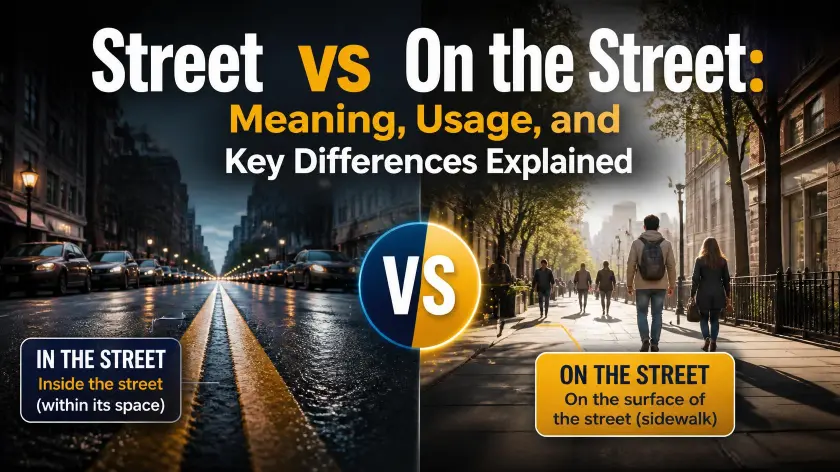
The difference between in the street vs on the street can confuse many English learners because both phrases seem almost identical. However, these expressions can have different meanings depending on the situation, location, and type of English being used.
Understanding when to use in the street and when to use on the street helps you communicate more naturally. These phrases appear often in daily conversations, news reports, stories, and professional writing. Choosing the correct expression can make your English sound clearer and more accurate.
The main difference comes down to position and perspective. On the street usually refers to being located on a street or connected with street life, while in the street often suggests being physically within the roadway or surrounded by the street area.
The Core Rule Explained Simply
The easiest way to understand in the street vs on the street is to think about the relationship between a person or object and the street.
On the street means something is located along the street, usually near buildings, sidewalks, addresses, or public areas.
Examples:
- “She lives on the street near the park.”
- “There is a new restaurant on the street.”
- “I saw him walking on the street.”
The phrase focuses on the street as a location or route.
In the street means something is physically inside the street area, often the road itself where vehicles travel.
Examples:
- “The children were playing in the street.”
- “A tree fell in the street.”
- “There was a large crowd in the street.”
The phrase focuses on being within the street space.
The difference is small, but the meaning changes.
The Two Primary Sides Explained
Side 1: When to Use “On the Street”
Use on the street when talking about a location, address, movement, or activity connected with a street.
The street is viewed as a surface, pathway, or named place.
Examples:
Location:
- “My office is on the street next to the bank.”
- “They opened a café on the street.”
Here, the street acts like a place where something exists.
Movement:
- “I saw a stranger walking on the street.”
- “People were dancing on the street during the festival.”
The person is using the street area as a public space.
Addresses:
- “The house is on Maple Street.”
- “The store is on Main Street.”
In English, addresses almost always use on.
Quick rule:
If you can replace the phrase with “located along the road”, on the street is usually correct.
Side 2: When to Use “In the Street”
Use in the street when something is actually inside the roadway or occupying the street area.
The street is viewed as an enclosed space or area.
Examples:
Physical position:
- “The ball rolled in the street.”
- “There is a car stopped in the street.”
The object is not simply beside the street. It is occupying the road.
Public gatherings:
- “Thousands of people gathered in the street.”
- “The protesters marched in the street.”
The phrase highlights that people are filling the street area.
Unexpected situations:
- “A dog was sitting in the street.”
- “Debris was left in the street.”
The object creates a situation within the roadway.
Quick rule:
If something is blocking, filling, or physically inside the road, use in the street.
Side-by-Side Comparison Table
| Situation | In the Street Example | On the Street Example | Meaning |
| Physical location | The children played in the street | The children walked on the street | In suggests inside the road, on suggests using the street area |
| Address | Incorrect: My house is in the street | My house is on the street | Addresses use on |
| Objects | A bicycle is in the street | A bicycle shop is on the street | Object position changes the phrase |
| Public activity | People gathered in the street | People performed on the street | Both possible, but focus changes |
| Transportation | A car stopped in the street | A taxi waited on the street | Road position vs street location |
Deep Dive Into Category 1: Using “On the Street”
When “On the Street” Is Correct
On the street is the more common phrase in everyday English. It describes something connected to a street rather than something physically inside the road.
Let’s make this concrete.
Imagine a neighborhood.
A bakery, a bookstore, and an apartment building are all on the street. They are positioned along the street, but they are not inside the road.
Examples:
- “There is a grocery store on the street.”
- “My friend lives on the street behind the school.”
- “The children waited on the street corner.”
The phrase works because these things relate to the street as a location.
Using “On the Street” for Addresses
One of the strongest rules is that addresses use on.
Examples:
- “She lives on Oak Street.”
- “The company is on River Road.”
- “The hotel is on Fifth Avenue.”
Never say:
- “She lives in Oak Street.”
That sounds unnatural because English treats streets as lines or surfaces where locations exist.
Using “On the Street” for Public Activities
Many activities happen on the street.
Examples:
- “Street musicians perform on the street.”
- “Artists sell paintings on the street.”
- “People celebrate festivals on the street.”
Here, the street is functioning as a public platform.
Quick Test for “On the Street”
Ask yourself:
Is the person or thing located near or along a street?
If yes, choose:
ON THE STREET
Checklist:
✓ Is it an address?
✓ Is it a business location?
✓ Is someone walking or standing there?
✓ Is the street being used as a public place?
If most answers are yes, on the street is likely correct.
Deep Dive Into Category 2: Using “In the Street”
When “In the Street” Is Correct
In the street emphasizes being inside the street area, especially the road.
This phrase often appears when something is unusual, temporary, or physically placed where vehicles normally move.
Examples:
- “There was water in the street after the storm.”
- “A child dropped a toy in the street.”
- “The workers repaired a hole in the street.”
The street is treated as a space that can contain things.
“In the Street” and Safety Situations
Many warnings use in the street because they describe danger or obstruction.
Examples:
- “Do not stand in the street.”
- “A vehicle was parked in the street.”
- “There are rocks in the street.”
The phrase tells listeners that something is physically occupying the roadway.
“In the Street” in Stories
Writers often use in the street to create a stronger image.
Example:
“The rain poured down, and people rushed through the street.”
This creates a picture of people surrounded by the street environment.
Another example:
“The old bicycle was abandoned in the street.”
The reader imagines the bicycle sitting directly on the road.
Quick Test for “In the Street”
Ask:
Could a car normally drive through this space?
If yes, and something is occupying that area, use:
IN THE STREET
Checklist:
✓ Is it inside the roadway?
✓ Is it blocking traffic?
✓ Is it physically placed there?
✓ Is the street being described as an area or space?
If yes, in the street is usually correct.
The Meaning Shift (or Nuance)
The difference between in the street vs on the street is not always about grammar alone. It is about the speaker’s viewpoint.
Consider these examples:
“The children are playing on the street.”
This sounds like children are using the street as a public area.
“The children are playing in the street.”
This suggests they are actually in the road, possibly where cars drive.
Both sentences can be correct, but the second one creates a stronger image of being inside the roadway.
Another example:
“There is a man on the street.”
This usually means a man is outside somewhere along a street.
“There is a man in the street.”
This suggests the man is standing in the road itself.
The choice changes the mental picture.
Why the Confusion Persists
The confusion exists because English uses many location prepositions in ways that are not always logical.
Learners often translate directly from their first language. Many languages use one general word for locations that English divides into different categories.
Another reason is that streets have multiple meanings.
A street can mean:
- A road for vehicles
- A public area
- A named location
- A neighborhood environment
Because of these meanings, both in and on can appear with the word street.
Here’s why:
English prepositions depend on how speakers imagine a place, not just its physical structure.
A street can be viewed as:
A surface or route, use on.
An enclosed area or space, use in.
This difference explains most examples.
Formal vs Casual Contexts
The choice between in the street vs on the street can also depend on the communication setting. In everyday conversations, native speakers often choose naturally without thinking about grammar rules. However, in formal writing, reports, and professional communication, choosing the right phrase improves clarity.
Formal Writing
In formal writing, both expressions can be correct, but the intended meaning must be clear.
Examples:
- “Residents gathered in the street to discuss the community issue.”
- “Several businesses opened on the street after the renovation project.”
The first sentence focuses on people occupying the road area. The second focuses on businesses located along a street.
Professional writers avoid confusion by choosing the phrase that matches the exact situation.
Casual Conversation
In casual speech, people frequently use on the street because it covers many everyday situations.
Examples:
- “I saw your brother on the street.”
- “There is a new coffee shop on the street.”
However, if someone is literally standing or sitting in the road, speakers often choose in the street.
Examples:
- “Why are you standing in the street?”
- “The kids left their bikes in the street.”
The context usually makes the meaning obvious.
Case Studies / Pop Culture Examples
Real-life situations show how the difference works.
Case Study 1: Street Performers
Street performers are usually described as being on the street.
Examples:
- “The musician played guitar on the street.”
- “Artists painted portraits on the street.”
The focus is on the street as a public performance space.
However, if a performer is physically positioned in the roadway, in the street may be used.
Example:
“The dancers stood in the street during the parade.”
The phrase highlights that the road itself was occupied.
Case Study 2: News Reports
News writing often uses both expressions.
Examples:
“Crowds gathered in the street after the announcement.”
This suggests a large group filling the road.
“New shops opened on the street after the development project.”
This describes businesses located along the road.
News writers choose based on whether they are describing location or occupation of space.
Case Study 3: Movies and Stories
Writers use these phrases to create different images.
Example:
“The detective walked on the street looking for clues.”
The focus is movement through an urban area.
Example:
“The detective found a mysterious object in the street.”
The object is physically located on the roadway.
Small preposition changes can create different scenes in storytelling.
Advanced Scenarios & Flowchart
Use this simple guide to decide between in the street and on the street:
Are you talking about a named road, address, business, or location?
|
Yes
|
Use: ON THE STREET
Example:
The restaurant is on the street near my office.
Are you talking about something physically inside the roadway?
|
Yes
|
Use: IN THE STREET
Example:
A fallen tree is in the street.
Are people using the street as a public space?
|
Yes
|
Both may work.
Ask:
Is the focus on location?
|
Use ON THE STREET
Is the focus on occupying the road?
|
Use IN THE STREET
Are you unsure?
|
Choose based on the image you want:
Location or connection = ON
Physical position inside the road = IN
Quick Reference Table
| Phrase | Main Meaning | Example |
| On the street | Located along a street or using it as a public place | The store is on the street near the station. |
| In the street | Physically inside the roadway | A bicycle was left in the street. |
Common Mistakes That Lower Quality
Even experienced English users sometimes confuse these expressions.
Mistake 1: Using “In” for Addresses
Incorrect:
“My office is in Green Street.”
Correct:
“My office is on Green Street.”
English uses on for street names and addresses.
Mistake 2: Using “On” for Road Obstacles
Incorrect:
“There is a fallen branch on the street blocking traffic.”
This sentence may be understood, but in the street is often clearer when describing something inside the roadway.
Better:
“There is a fallen branch in the street blocking traffic.”
Mistake 3: Assuming One Phrase Always Works
Some learners memorize one phrase and use it everywhere.
For example:
“I saw a dog on the street.”
This can be correct.
However:
“The dog was sleeping in the street.”
creates a different image.
The best choice depends on meaning.
Mistake 4: Ignoring British and American Differences
English varieties may sometimes differ in preference.
In general, both American and British English use on the street for locations and addresses.
However, descriptions of street activity may vary depending on the speaker’s perspective.
Mistake 5: Forgetting the Visual Picture
A common error is focusing only on grammar rules.
Instead, imagine the scene.
Is something beside or along the street?
Use:
On the street
Is something occupying the road?
Use:
In the street
Memory Hacks That Actually Work
Remembering these phrases becomes easier with simple visual tricks.
Memory Hack 1: On = Outside Location
Think:
On the street means on the street map.
Addresses appear as lines on maps.
Examples:
- on Main Street
- on Oak Avenue
- on River Road
Memory Hack 2: In = Inside Space
Think:
In means inside.
If something is surrounded by the street area, use in.
Examples:
- a car in the street
- a crowd in the street
- debris in the street
Memory Hack 3: Think About Traffic
Ask:
“Would a car drive here?”
If yes, something occupying that area is probably in the street.
Example:
“The truck is in the street.”
The truck is where traffic normally moves.
Memory Hack 4: Think About Buildings
Buildings are connected to streets, not inside them.
Examples:
- The library is on the street.
- The apartment is on the street.
This reminder helps with addresses.
Memory Hack 5: Create Two Mental Pictures
Picture one:
A row of shops and houses.
Use:
ON THE STREET
Picture two:
A road filled with people, objects, or vehicles.
Use:
IN THE STREET
Why Precision Matters (SEO/Authority)
Using the correct phrase improves the quality and credibility of your writing. Small grammar choices influence how professional and natural your content appears.
For websites, blogs, educational materials, and business communication, accurate preposition use helps readers understand information quickly.
Search engines and readers both value content that is:
- Clear
- Natural
- Easy to understand
- Well written
Consider these examples:
“The company opened a store in the street.”
A reader may wonder whether the store is physically located in the road.
“The company opened a store on the street.”
This immediately communicates that the store is located along that street.
Precision prevents confusion.
Strong writing is not only about using advanced vocabulary. It is about choosing simple words correctly.
Understanding differences like in the street vs on the street helps writers create content that feels fluent and trustworthy.
A Quick Quiz
Fill in the blanks with in the street or on the street.
1. My favorite restaurant is located ______ near the library.
Answer: on the street
2. The children were playing ______ after school.
Answer: in the street or on the street, depending on whether they were in the roadway or simply outside.
3. A new bookstore opened ______ last month.
Answer: on the street
4. There was a broken sign lying ______ after the storm.
Answer: in the street
5. She lives ______ next to the park.
Answer: on the street
6. The parade filled ______ with thousands of people.
Answer: in the street
7. The workers found a damaged pipe ______ during repairs.
Answer: in the street
8. Several cafés are located ______ in the downtown area.
Answer: on the street
Conclusion
The difference between in the street vs on the street depends on how you view the street. When you are talking about a location, address, business, or something connected to a road, on the street is usually the correct choice. When you are describing something physically inside the roadway or occupying the road space, in the street works better. The two phrases may look similar, but they create different images in the reader’s mind. Understanding this small distinction can make everyday conversations and professional writing sound more natural.
Mastering prepositions requires paying attention to context rather than memorizing isolated rules. Think of on the street as describing a place along a route, while in the street describes something inside that space. Whether you are writing an article, speaking with others, or learning English, choosing the right phrase improves clarity. These small language details build stronger communication skills and help your writing sound more fluent, accurate, and confident.
Frequently Asked Questions
Is “in the street” or “on the street” more common?
On the street is generally more common because it is used for addresses, locations, and everyday descriptions. People often say someone lives on a street, works on a street, or walks on a street. However, in the street is also common when describing something physically located within the roadway.
Do Americans and British speakers use these phrases differently?
Both American and British English use on the street for addresses and locations. The difference is usually not about nationality but about the speaker’s intended meaning. Both varieties use in the street when emphasizing that someone or something is actually occupying the road area.
Can “in the street” and “on the street” be interchangeable?
Sometimes they can describe similar situations, but they are not always interchangeable. For example, “a person on the street” may simply mean someone outside, while “a person in the street” suggests the person is standing in the road. The correct choice depends on the image you want to create.
Should I say “I live in the street” or “I live on the street”?
You should say “I live on the street” when referring to an address or location. Saying “I live in the street” usually suggests that someone lives physically inside the roadway, which is not the intended meaning in normal situations.
Is “on the street” used for street names?
Yes, on is used with street names. Examples include “I live on King Street” or “The office is on Pine Avenue.” English treats streets as locations where buildings and businesses are placed, so on is the standard preposition.
Why do we say “on the street” instead of “in the street” for addresses?
We say on the street because a street is viewed as a line or surface where locations exist. Buildings, stores, and homes are positioned along that line rather than inside the road. This is why addresses normally use the preposition on.
Which phrase should I use when describing someone walking?
Usually, use walking on the street because the person is traveling along the street. However, if you want to emphasize that the person is walking directly in the roadway rather than on a sidewalk, walking in the street may be more accurate.
Is “street” considered a place or an area in these phrases?
A street can represent different ideas. In on the street, it often acts as a named place or route. In in the street, it acts more like an area or space that can contain objects and people.
How can I remember the difference quickly?
Remember this simple rule: on means location along a street, in means inside the street space. Houses, stores, and addresses are usually on the street. Cars, crowds, and objects blocking the road are usually in the street.
Which phrase sounds more natural in everyday English?
Both phrases sound natural when used correctly. However, on the street appears more often because it covers many common situations. When describing something physically placed in the roadway, in the street sounds more precise and natural.

Caroline Stewart is a dedicated writer and English language enthusiast who enjoys making everyday English easier to understand. At Grammarzcore, she creates clear, practical content covering grammar, word meanings, sentence usage, and common language questions. Her goal is to turn confusing English topics into simple, useful explanations that readers can apply with confidence. Caroline writes for students, professionals, and anyone looking to strengthen their English skills and communicate more naturally, accurately, and effectively in everyday life.