
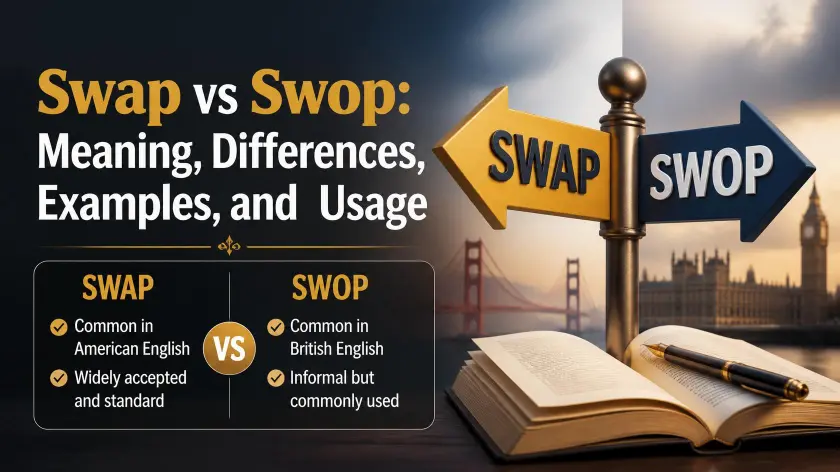
The difference between swap vs swop often confuses English learners because both words describe the idea of exchanging one thing for another. They look almost identical, sound the same in many accents, and are sometimes used interchangeably. However, their usage depends on regional spelling preferences and language style.
Understanding whether to use swap or swop helps you write more accurately and communicate clearly. In most modern English contexts, swap is the preferred and widely accepted spelling, while swop is mainly associated with British English and some regional varieties.
This guide explains the core difference between swap and swop, shows real examples, compares their meanings, and helps you choose the correct word for any situation.
The Core Rule Explained Simply
The simplest rule is this:
Swap and swop both mean to exchange one thing for another, but “swap” is the standard spelling used almost everywhere.
The word swap is common in American English, British English, Canadian English, Australian English, and international writing.
Example:
- “I will swap seats with you.”
- “They decided to swap their old phones.”
The word swop has the same meaning but is less common.
Example:
- “The children wanted to swop toys during playtime.”
Today, many dictionaries recognize both spellings, but swap is considered the safer choice for general writing.
Here’s why:
Language changes over time. A spelling that was once common in one region may become less popular as global communication increases.
The Two Primary Sides of Swap vs Swop
Side 1: Swap, The Modern Standard Choice
Swap is the dominant spelling in contemporary English.
It works as both:
- A verb
- A noun
As a verb:
- “Can we swap places?”
- “She swapped her jacket for a sweater.”
As a noun:
- “We made a book swap at school.”
- “The trade was a fair swap.”
Because it appears frequently in books, websites, business communication, and everyday speech, swap is usually the recommended option.
Side 2: Swop, The Regional Alternative
Swop is an alternative spelling of the same word.
It is mostly found in:
- British English writing
- Older texts
- Informal communication
- Some regional communities
Examples:
- “The players decided to swop positions.”
- “I want to swop this item for another one.”
Although understandable, swop may look unusual to many readers, especially outside regions where it is still used.
Side-by-Side Comparison Table
| Aspect | Swap | Swop | Correct Usage |
| Meaning | To exchange one thing for another | To exchange one thing for another | Both can be correct |
| Popularity | Very common worldwide | Less common | Prefer swap in most cases |
| English Variety | Used internationally | Mainly British and regional use | Depends on audience |
| Example | “Let’s swap books.” | “Let’s swop books.” | “Swap” is usually safer |
Deep Dive into Category 1: Understanding “Swap”
When to Use Swap
The word swap should be your first choice in almost every modern English situation.
It is used when people exchange:
- Objects
- Positions
- Ideas
- Responsibilities
- Services
- Information
Let’s make this concrete.
Example 1: Everyday Exchange
“I swapped my sandwich with my friend.”
Meaning:
Two people exchanged items.
Example 2: Changing Positions
“We swapped seats before the movie started.”
Meaning:
Two people changed places.
Example 3: Sharing Responsibilities
“My coworker and I swapped shifts.”
Meaning:
They exchanged work schedules.
Example 4: Financial or Business Context
“The companies swapped resources to improve efficiency.”
Meaning:
They exchanged useful assets.
Example 5: Digital Context
“I swapped my old phone for a newer model.”
Meaning:
An old item was exchanged for another.
Common Patterns With Swap
The word swap appears in several common structures.
Swap + Object
Pattern:
swap + something
Examples:
- “I swapped my shoes.”
- “She swapped her book.”
Swap A for B
Pattern:
swap A for B
Examples:
- “He swapped coffee for tea.”
- “They swapped the car for a bicycle.”
Swap With Someone
Pattern:
swap with + person
Examples:
- “I swapped seats with my brother.”
- “She swapped notes with her classmate.”
Swap Between Two Things
Pattern:
swap between + options
Example:
- “You can swap between different settings.”
Quick Test for Using Swap
Ask yourself:
1. Am I describing an exchange?
If yes, swap probably works.
2. Am I writing for a general audience?
If yes, choose swap.
3. Would most international readers understand it immediately?
If yes, swap is the better choice.
Quick checklist:
✔ Exchange is happening
✔ Two things are changing places
✔ Writing is modern or professional
✔ Audience is international
Use swap.
Deep Dive into Category 2: Understanding “Swop”
When to Use Swop
Swop is not incorrect, but it is less common.
It follows the same meaning as swap.
Examples:
- “The children agreed to swop stickers.”
- “They decided to swop houses for a week.”
The main difference is not meaning. It is frequency and audience expectations.
A British reader may recognize swop easily, but many international readers may consider it unusual.
Why Does Swop Exist?
English often has alternative spellings because different regions develop different preferences.
Examples:
- Colour vs color
- Centre vs center
- Travelled vs traveled
Similarly:
- Swap vs swop
Both can exist, but one usually becomes more dominant.
In this case, swap became the global standard.
Common Patterns With Swop
The patterns are identical to swap.
Swop Something
Example:
“They wanted to swop gifts.”
Swop A for B
Example:
“I decided to swop my old book for a new one.”
Swop With Someone
Example:
“She swopped places with her friend.”
However, these structures appear less frequently in modern writing.
Quick Test for Using Swop
Ask:
1. Is my audience familiar with British regional spelling?
If yes, swop may work.
2. Am I writing casually?
If yes, it can be acceptable.
3. Am I writing internationally or professionally?
If yes, choose swap instead.
Quick checklist:
✔ Regional British usage
✔ Informal setting
✔ Audience understands the spelling
Swop can be used.
The Meaning Shift or Nuance
The biggest difference between swap and swop is not meaning. It is perception.
Both words communicate the same basic idea:
To exchange one thing for another.
However, they create slightly different impressions.
Swap Feels:
- Modern
- International
- Common
- Professional
- Standard
Example:
“We decided to swap ideas during the meeting.”
This sounds natural everywhere.
Swop Feels:
- Regional
- Traditional
- Less common
- Informal
Example:
“We decided to swop ideas.”
This is understandable but may appear unusual to some readers.
The meaning remains the same, but the spelling affects how readers perceive the text.
Why the Confusion Persists
The confusion between swap vs swop continues because the difference is extremely small.
Both words:
- Look similar
- Sound identical
- Have the same definition
- Are accepted in some dictionaries
Here’s why people hesitate:
Similar Appearance
The only difference is one letter.
Swap:
S W A P
Swop:
S W O P
A single vowel change makes people question which version is correct.
Regional Differences
English changes depending on location.
A writer who grew up seeing swop may naturally use it.
A writer exposed mainly to American or international English will usually choose swap.
Dictionary Recognition
Because both forms exist, people may assume they are equally common.
However, acceptance does not always mean equal popularity.
A word can be correct but uncommon.
Internet Influence
Online communication has increased the dominance of widely recognized spellings.
Since swap appears more frequently online, it has become the expected spelling for many readers.
Formal vs Casual Contexts
Understanding the difference between swap vs swop becomes easier when you consider the situation where you are writing or speaking. Although both words can describe an exchange, the setting often determines which spelling feels more natural.
In most formal contexts, swap is the better choice. It is widely accepted in professional writing, academic work, business documents, and international communication.
Examples:
- “The two departments will swap responsibilities during the transition.”
- “The companies agreed to swap data to improve collaboration.”
- “Students can swap research materials during the project.”
These sentences sound natural because swap is the standard form most readers expect.
In casual situations, both words may appear.
Examples:
- “Do you want to swap snacks?”
- “Let’s swop books after we finish reading.”
However, even in casual writing, swap remains more common.
Here’s why:
A familiar spelling helps readers understand your message quickly. When a less common spelling appears, some readers may pause and wonder whether it is a mistake.
Professional Writing Examples
Business Communication
Businesses usually choose swap because it creates a clear and modern impression.
Example:
“The teams will swap information before the final presentation.”
This sounds professional and easy to understand.
Using swop would not necessarily be wrong, but it may appear less familiar.
Academic Writing
Academic writing generally favors common, standardized vocabulary.
Example:
“Participants were asked to swap answers with a partner.”
Swap fits naturally because it is widely recognized.
Digital Content
Websites, blogs, and online platforms typically use swap.
Examples:
- “How to swap currencies online”
- “Ways to swap clothes sustainably”
- “Best apps to swap items”
The digital world strongly favors the more common spelling.
Casual Conversations
In everyday speech, the difference is almost invisible because most speakers pronounce both words the same.
Examples:
- “Want to swap seats?”
- “Can we swap games?”
- “Let’s swap places.”
Most people will naturally choose swap because they encounter it more often.
A person using swop may still be understood, especially in regions where the spelling is familiar.
Case Studies / Pop Culture Examples
Real-world usage shows how swap has become the dominant form.
Example 1: Trading and Collecting Communities
Many collecting communities use the term swap.
Examples:
- Card swaps
- Book swaps
- Clothing swaps
- Toy swaps
A community event might advertise:
“Join our neighborhood book swap.”
This sounds natural because swap is immediately recognizable.
Example 2: Technology and Gaming
Technology frequently uses the word swap.
Examples:
- “Swap your old device for a new one.”
- “Swap characters during gameplay.”
- “Swap files between systems.”
The technology world usually avoids less common spellings because global audiences need instant understanding.
Example 3: Movies and Entertainment
The idea of swapping appears often in entertainment.
Common story themes include:
- Body swaps
- Identity swaps
- Role swaps
- Life swaps
For example, the phrase “body swap” is widely recognized.
The spelling “body swop” would look unusual to many readers.
Example 4: Education
Schools often organize activities involving exchanges.
Examples:
- Book swaps
- Uniform swaps
- Skill swaps
Teachers usually choose swap because students from different backgrounds understand it easily.
Advanced Scenarios & Flowchart
Use this simple decision flowchart to choose between swap and swop:
Start:
Are you describing an exchange between two things or people?
|
Yes
|
Do you want the most widely accepted spelling?
|
Yes
|
Use: SWAP
No
|
Is your audience familiar with British regional spelling?
|
Yes
|
Use: SWOP
No
|
Use: SWAP
Another decision path:
Is this professional, academic, or online content?
|
Yes
|
Choose SWAP
Is this personal writing in a region where SWOP is common?
|
Yes
|
Either may work
Are you unsure?
|
Yes
|
Choose SWAP
The safest answer is simple:
When in doubt, use swap.
Quick Reference Table
| Word | Meaning | Best Use |
| Swap | Exchange one thing for another | General, professional, international writing |
| Swop | Exchange one thing for another | Regional or informal British usage |
Common Mistakes That Lower Quality
Even experienced writers sometimes make mistakes when choosing between swap and swop.
Mistake 1: Thinking They Have Different Meanings
A common misunderstanding is believing that swap and swop describe different actions.
They do not.
Both mean:
To exchange something.
The difference is spelling preference.
Mistake 2: Using Swop in International Content
A writer may choose swop because it looks correct.
However, international readers may find it unfamiliar.
Example:
Less effective:
“Users can swop their points for rewards.”
Better:
“Users can swap their points for rewards.”
The second version feels more natural globally.
Mistake 3: Assuming Rare Means Incorrect
Some people think swop is wrong because they rarely see it.
That is not true.
A word can be uncommon without being incorrect.
Mistake 4: Ignoring Audience Expectations
The correct spelling depends partly on who will read your content.
A local British audience may accept swop easily.
A global audience will usually expect swap.
Mistake 5: Mixing Spellings
Consistency matters.
Avoid writing:
“Users can swap items and swop services.”
Choose one spelling and use it throughout your content.
Memory Hacks That Actually Work
Remembering the difference between swap vs swop is simple with a few tricks.
Memory Hack 1: Choose the A for All
Think:
Swap with A = Accepted almost everywhere
The letter “A” reminds you that swap is the safer choice.
Memory Hack 2: Swap Is the Standard
Remember:
Swap = Standard
Both words begin with “S,” but swap is the spelling used most widely.
Memory Hack 3: Swop Sounds Older
Think of swop as a less common regional spelling.
This does not mean it is wrong, but it is less likely to be expected.
Memory Hack 4: Online Uses Swap
Most websites use:
- Swap apps
- Swap markets
- Swap services
- Swap options
If you write for the internet, swap is usually the better option.
Memory Hack 5: When Unsure, Swap
A simple rule:
Confused? Pick swap.
It works in nearly every situation.
Why Precision Matters (SEO/Authority)
Using the correct word choice improves clarity, trust, and professionalism. This matters especially in SEO content, where readers and search engines evaluate the quality of information.
A website using familiar language creates a better user experience.
For example:
A searcher looking for information about exchanging items will expect terms like:
- “How to swap products”
- “Best ways to swap items”
- “Where to swap books”
The word swap matches common search behavior.
Using uncommon alternatives may not always harm ranking, but it can affect readability and audience confidence.
Strong content focuses on:
- Clear vocabulary
- Natural language
- Reader expectations
- Consistent spelling
Choosing swap instead of swop in most situations helps your content feel modern and accessible.
Precision also builds authority.
Readers trust writing that feels polished. Small spelling choices can influence how professional your message appears.
A Quick Quiz
Fill in the blanks:
1. I want to ______ my old jacket for a new one.
Answer: swap
2. The students decided to ______ books after class.
Answer: swap or swop, depending on regional preference.
3. Which spelling is more common worldwide, ______ or swop?
Answer: swap
4. In professional writing, you should usually choose ______.
Answer: swap
5. Both swap and swop have the same ______.
Answer: meaning
6. If you are writing for an international audience, the safer choice is ______.
Answer: swap
7. Swop is mainly considered a ______ spelling.
Answer: regional
8. The words swap and swop describe the act of ______ something.
Answer: exchanging
Conclusion
The difference between swap vs swop is simple once you understand the main rule: both words mean to exchange one thing for another, but swap is the spelling preferred in modern English. It is widely recognized across countries, works well in professional and casual situations, and is the better choice for most writers. Swop is still accepted in some regional varieties, especially British English, but it appears less frequently. Choosing the right spelling helps your writing feel natural, clear, and accessible to a wider audience.
When deciding between swap and swop, think about your readers and the purpose of your message. If you are writing an article, email, website page, academic document, or professional communication, swap is usually the strongest option. If you are using a regional style where swop is common, it can still be appropriate. The key is consistency and awareness. Small word choices influence how readers perceive your writing, so understanding these subtle differences helps you communicate with greater confidence and accuracy.
Frequently Asked Questions
Is swap or swop the correct spelling?
Both swap and swop are considered correct spellings because they have the same meaning, which is to exchange something. However, swap is the more common and widely accepted spelling today. It is the preferred choice in international writing, professional communication, and most online content because readers are more familiar with it.
Does swap and swop have different meanings?
No, swap and swop do not have different meanings. Both words describe exchanging one thing for another. For example, “I will swap books with my friend” and “I will swop books with my friend” communicate the same idea. The difference is mainly related to spelling preference and regional usage rather than definition.
Which word should I use in formal writing, swap or swop?
In formal writing, swap is usually the better choice. It is more common in business documents, academic writing, websites, and professional communication. While swop is not necessarily wrong, some readers may consider it unusual. Using the more familiar spelling helps your writing appear polished and easier to understand.
Is swop still used today?
Yes, swop is still used today, especially in some British English contexts and certain regional communities. However, it is much less common than swap. Many people recognize swop, but they are more likely to expect the spelling swap when reading modern English content.
Why do people confuse swap and swop?
People confuse these words because they look almost identical, sound the same, and share the same meaning. The only difference is the vowel in the middle. Since both spellings exist in English, writers may wonder whether one is incorrect, but the real difference is popularity and regional preference.
Is swap better for SEO content than swop?
Yes, swap is usually better for SEO content because it matches common search behavior and reader expectations. Online users are more likely to search for phrases containing “swap,” such as “item swap,” “currency swap,” or “how to swap products.” Using familiar vocabulary improves readability and user experience.
Can I use swop in an American English article?
You can use swop, but it may look unusual to many American readers. American English strongly favors the spelling swap. If your article targets a general or international audience, choosing swap will make your content clearer and more natural.
Is swap a noun or a verb?
Swap can be both a noun and a verb. As a verb, it means to exchange something, such as “They swapped seats.” As a noun, it refers to an exchange itself, such as “The book swap was successful.” Swop can also function in the same ways, although it is less common.
Should I use swap or swop in everyday conversation?
In everyday conversation, swap is the safest choice because most English speakers recognize it immediately. You can say “Let’s swap places” or “Can we swap items?” without sounding unusual. Swop may still be understood, but swap is more natural in most conversations.
How can I remember the difference between swap and swop?
A simple memory trick is: swap with A is accepted almost everywhere. The letter A can remind you that swap is the standard choice. When you are unsure which spelling to use, choose swap because it works in nearly all modern English situations.

Callum Mercer is a passionate writer and language enthusiast dedicated to making English easier to understand and use. At Grammarzcore, he shares clear, practical guidance on grammar, word meanings, sentence structure, and everyday English. His writing focuses on explaining confusing language questions in a simple, approachable way, helping students, professionals, and everyday readers communicate with greater clarity and confidence. Callum believes that learning English should feel useful, engaging, and accessible, one well-written sentence at a time.