
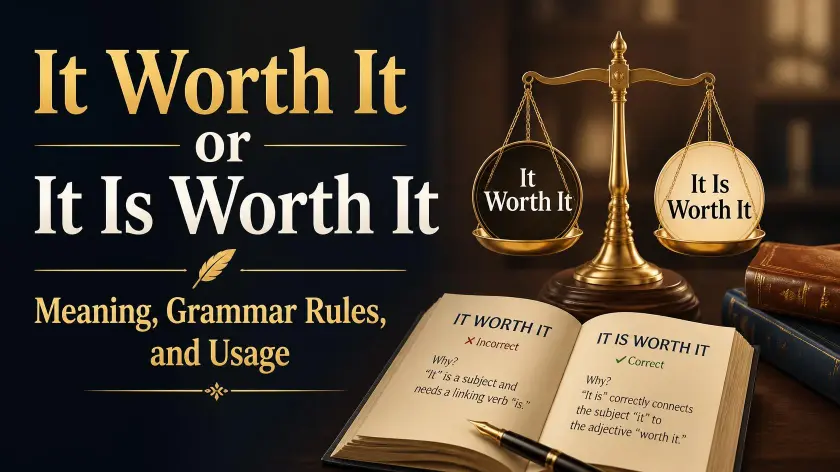
The phrase “it worth it or it is worth it” is a common English confusion that appears in conversations, writing, and online searches. Many learners wonder whether the shorter version is acceptable or whether the complete form is always required. The answer depends on understanding how English sentences are structured.
The correct phrase in standard English is “it is worth it.” The phrase “it worth it” is missing the verb is, which makes it grammatically incomplete in most situations.
English sentences usually need a subject and a verb. In “it is worth it,” the word it acts as the subject, is works as the linking verb, and worth it describes the value or benefit of something.
Understanding this small grammar point helps you speak more naturally, write more accurately, and avoid a common mistake made by many English learners.
The Core Rule Explained Simply
The basic rule is:
Use “it is worth it” when you want to say something has enough value, benefit, or importance to justify the effort, cost, or time.
Examples:
- “The course is expensive, but it is worth it.”
- “The trip was long, but it is worth it.”
- “Learning English takes time, but it is worth it.”
The phrase means something is valuable despite difficulties.
The phrase “it worth it” is usually incorrect because English requires a verb between the subject and the description.
Incorrect:
- “This phone is costly, but it worth it.”
Correct:
- “This phone is costly, but it is worth it.”
The missing word is creates the grammar problem.
The Two Primary Sides of the Topic
Side 1: Understanding “It Is Worth It”
“It is worth it” is the complete and grammatically correct expression.
The phrase follows this structure:
Subject + linking verb + adjective phrase
Example:
- It + is + worth it.
The word worth works differently from many adjectives. It describes value or usefulness.
Examples:
- “The movie is worth it.”
- “The investment is worth it.”
- “The effort is worth it.”
In each example, the speaker says that something provides enough value.
Side 2: Understanding Why “It Worth It” Appears
Although “it worth it” is not standard grammar, people may still write or say it because of several reasons.
One reason is that English speakers often shorten phrases in informal communication.
Examples from casual speech:
- “Worth it!”
- “Totally worth it!”
- “Definitely worth it!”
These shortened expressions remove the subject because the meaning is already understood.
However, this does not mean:
- “It worth it”
is correct.
The correct shortened version removes it, not is.
Correct informal:
- “Worth it.”
Incorrect:
- “It worth it.”
Side-by-Side Comparison Table
| Situation | Example | Meaning | Correct Usage |
| Complete sentence | It is worth it. | Something has enough value | Correct |
| Casual response | Worth it. | Short way to say something has value | Correct |
| Missing verb | It worth it. | Incomplete sentence | Incorrect |
| Past situation | It was worth it. | Something had value before | Correct |
| Future situation | It will be worth it. | Something will have value later | Correct |
Deep Dive Into Category 1: When to Use “It Is Worth It”
Explaining Value or Benefit
The main use of “it is worth it” is to explain that something provides enough benefit to justify an action.
Examples:
- “The training is difficult, but it is worth it.”
- “The extra work is tiring, but it is worth it.”
- “The new computer costs more, but it is worth it.”
The phrase often appears after discussing a challenge.
The speaker acknowledges a negative point but explains that the final result is valuable.
Talking About Money
One of the most common uses involves purchases.
Examples:
- “The laptop is expensive, but it is worth it.”
- “The restaurant costs more than others, but it is worth it.”
- “The tickets were expensive, but they were worth it.”
Here, worth it means the quality or experience matches the price.
Talking About Time and Effort
The phrase also applies to actions.
Examples:
- “Studying every day is hard, but it is worth it.”
- “Waiting in line was annoying, but it was worth it.”
- “Practicing regularly is difficult, but it is worth it.”
The value does not have to be financial.
It can refer to:
- Time
- Energy
- Experience
- Personal growth
- Results
Talking About Decisions
People often use this phrase when explaining choices.
Examples:
- “Moving to another city was scary, but it was worth it.”
- “Starting a business was risky, but it was worth it.”
- “Taking that opportunity was worth it.”
The phrase shows that the outcome justified the decision.
Quick Test for “It Is Worth It”
Ask:
Am I saying something has enough value to justify something else?
If yes, use:
It is worth it.
Checklist:
✓ Am I describing value?
✓ Am I explaining a benefit?
✓ Am I comparing effort with results?
✓ Am I saying something was a good choice?
If yes, it is worth it is the correct phrase.
Deep Dive Into Category 2: Understanding Other Forms of “Worth It”
“Was Worth It”
Use was worth it for past situations.
Examples:
- “The journey was worth it.”
- “The experience was worth it.”
- “The wait was worth it.”
The action already happened.
The speaker is looking back and judging the value.
“Will Be Worth It”
Use will be worth it for future situations.
Examples:
- “The preparation will be worth it.”
- “The money spent will be worth it.”
- “The effort will be worth it.”
The speaker believes future benefits will justify current effort.
“Is It Worth It?”
Use this question form when asking whether something has enough value.
Examples:
- “Is it worth it to buy this phone?”
- “Is it worth it to learn another language?”
- “Is it worth it to travel that far?”
This is one of the most common question patterns.
“It’s Worth It”
In everyday English, it’s worth it is extremely common.
“It’s” is a contraction of:
It is
Examples:
- “Don’t worry, it’s worth it.”
- “The experience is challenging, but it’s worth it.”
- “Trust me, it’s worth it.”
This is correct in both casual and many professional situations.
“Worth It” Without “It Is”
Sometimes speakers simply say:
- “Worth it.”
- “Absolutely worth it.”
- “Completely worth it.”
These are informal sentence fragments, but they are natural in conversation.
Examples:
Question:
“Was the movie good?”
Answer:
“Definitely worth it.”
The complete meaning is:
“It was definitely worth it.”
The Meaning Shift or Nuance
The difference between it worth it and it is worth it is not really about meaning. It is about grammar completeness.
Both phrases are intended to express the same idea, but only one follows standard English structure.
Compare:
Incorrect:
“Buying this phone, it worth it.”
Correct:
“Buying this phone, it is worth it.”
The second sentence clearly connects the subject and description.
The phrase worth it itself means:
- Valuable enough
- Good enough
- Beneficial enough
- Justified by the result
Examples:
“The movie was worth it.”
Meaning:
“The movie provided enough enjoyment to justify the cost or time.”
“The course is worth it.”
Meaning:
“The course provides enough benefit to justify taking it.”
The important point is that worth it needs a verb when it follows a subject.
Why the Confusion Persists
The confusion exists because English often allows shortened expressions in casual speech.
People frequently say:
- “Worth it.”
- “Not worth it.”
- “Totally worth it.”
Because these phrases are common, learners may assume that removing words is always acceptable.
However, there is a difference between:
A natural short expression
and
A grammatically incorrect sentence.
“Worth it” works because it is an understood fragment.
“It worth it” does not work because it attempts to create a full sentence without a verb.
Another reason is that many languages do not require linking verbs in the same way English does.
Learners may translate directly and remove “is.”
English, however, usually requires:
- I am happy.
- She is ready.
- It is worth it.
The linking verb connects the subject with the description.
Formal vs Casual Contexts
The phrase “it is worth it” works well in both formal and casual situations. However, the way people use it may change depending on the setting.
In professional writing, academic discussions, or business communication, using the complete form is usually better.
Examples:
- “The additional investment is worth it because it improves long-term efficiency.”
- “The research process was challenging, but it was worth it.”
- “The training program requires commitment, but it is worth it.”
The complete phrase sounds clear and polished.
In casual conversations, speakers often shorten the expression.
Examples:
- “Trust me, it’s worth it.”
- “The trip was worth it.”
- “Worth it!”
These shortened forms are natural because listeners understand the missing words from context.
Here’s why:
The difference is not about correctness alone. It is also about the level of detail needed. A formal sentence usually needs complete grammar, while casual speech allows more flexibility.
Professional Examples
Imagine someone writing a product review.
Less effective:
“This laptop expensive, but it worth it.”
Better:
“This laptop is expensive, but it is worth it.”
The second version sounds more reliable and professional.
Now consider a workplace conversation:
Manager:
“Do you think we should spend extra money on this software?”
Employee:
“Yes, it is worth it because it saves time.”
This sounds appropriate because the speaker gives a complete explanation.
Casual Examples
Friends often use shorter expressions.
Friend:
“Was the concert good?”
Reply:
“Absolutely worth it!”
This is natural because the full meaning is already understood:
“It was absolutely worth it.”
The important rule is:
Shorten “it is worth it” to “worth it,” not “it worth it.”
Case Studies and Real-World Examples
Understanding how native speakers use the phrase makes the rule easier to remember.
Example 1: Travel Decisions
Someone may say:
“The flight was expensive, but it was worth it.”
Meaning:
The cost was high, but the experience justified the expense.
Incorrect:
“The flight was expensive, but it worth it.”
The sentence fails because was or is is missing.
Example 2: Education
Students often describe difficult learning experiences.
Correct:
“Learning a new language takes years, but it is worth it.”
The phrase shows that the final benefit is greater than the effort required.
Example 3: Technology Purchases
A customer might write:
“The phone costs more than other models, but it is worth it.”
Here, worth it describes value compared with the price.
Example 4: Personal Growth
People commonly use the phrase for challenging experiences.
Examples:
- “The early mornings were difficult, but they were worth it.”
- “The extra practice was worth it.”
- “The hard work is worth it.”
The phrase connects difficulty with a positive outcome.
Example 5: Movies and Entertainment
Reviews often use this expression.
Examples:
- “The movie is worth it for the amazing visuals.”
- “The show was worth it despite the long episodes.”
The meaning remains the same, something provides enough enjoyment or value.
Advanced Scenarios and Flowchart
Use this simple decision flowchart to choose the correct phrase:
Start:
Are you describing whether something has value or benefit?
Yes:
Do you need a complete sentence?
Yes:
Use “it is worth it.”
Example:
“The experience is difficult, but it is worth it.”
No:
Is it a casual reply?
Yes:
Use “worth it.”
Example:
“Was the trip good?”
“Worth it.”
No:
Use the complete phrase.
No:
Do not use “worth it.”
Choose another expression.
Remember:
Subject + missing verb?
Add “is,” “was,” or “will be.”
Talking about the past?
Use “was worth it.”
Talking about the future?
Use “will be worth it.”
Asking a question?
Use “Is it worth it?”
Quick Reference Table
| Phrase | Meaning | Example |
| It is worth it | Something has enough value | “The course is worth it.” |
| It was worth it | Something had value in the past | “The trip was worth it.” |
| It will be worth it | Something will have value later | “The effort will be worth it.” |
| Is it worth it? | Asking about value | “Is it worth it to buy?” |
| Worth it | Casual shortened response | “Yes, totally worth it.” |
| It worth it | Missing verb, incorrect | Avoid this form |
Common Mistakes That Lower Quality
Even experienced English learners can make mistakes with this phrase.
Mistake 1: Removing “is” Completely
Incorrect:
- “The price is high, but it worth it.”
Correct:
- “The price is high, but it is worth it.”
The verb is connects the subject to the description.
Mistake 2: Confusing “Worth” With Other Adjectives
Some learners treat worth like a regular adjective.
They may think:
“It good.”
becomes:
“It worth it.”
But English requires:
“It is good.”
“It is worth it.”
Both need a linking verb.
Mistake 3: Using “Worth It” in Formal Writing Without Context
A phrase like:
“Worth it.”
may work in a text message, but a report should use:
“The investment was worth it because it increased productivity.”
Mistake 4: Using the Wrong Tense
Incorrect:
“The experience is last year, but it is worth it.”
Better:
“The experience happened last year, but it was worth it.”
The verb should match the time.
Mistake 5: Adding Extra Words Incorrectly
Incorrect:
“It is worth for it.”
Correct:
“It is worth it.”
The phrase has a fixed structure.
Memory Hacks That Actually Work
Remember these simple tricks:
Memory Hack 1: “No Verb, No Sentence”
If you see it at the beginning of a sentence, ask:
“Where is the verb?”
Correct:
- It is worth it.
- It was worth it.
- It will be worth it.
Incorrect:
- It worth it.
Memory Hack 2: Think of “Worth It” as a Team
The phrase works as a unit:
worth + it
Do not separate it.
Examples:
Correct:
- It is worth it.
- It was worth it.
Incorrect:
- It is worth for it.
Memory Hack 3: Remember the Short Version
The only common shortened version is:
It is → It’s
So:
Full:
“It is worth it.”
Short:
“It’s worth it.”
Not:
“It worth it.”
Memory Hack 4: Use the “Value Test”
Ask:
“Am I saying something gives enough value?”
If yes:
Use:
worth it
Then add the correct verb.
Examples:
- “The job is worth it.”
- “The effort was worth it.”
- “The wait will be worth it.”
Why Precision Matters (SEO and Authority)
Using correct phrases like “it is worth it” improves the quality of your communication. Small grammar mistakes can affect how readers judge your writing, especially in professional, academic, and online environments.
Search engines and readers both value clear, trustworthy content. When articles, reviews, or websites use accurate grammar, they appear more reliable and authoritative.
For example, a product review saying:
“This phone is expensive, but it is worth it.”
sounds professional.
A review saying:
“This phone expensive, but it worth it.”
creates doubt because the writing appears less polished.
Grammar accuracy builds credibility.
This matters especially for:
- Blog writers
- Business owners
- Students
- Content creators
- Professionals
Clear language helps readers focus on your message instead of noticing mistakes.
A Quick Quiz
Fill in the blanks with the correct phrase.
1. The restaurant was expensive, but ______.
a) it worth it
b) it was worth it
c) worth was it
Answer: b) it was worth it
2. I know the work is difficult, but ______.
a) it is worth it
b) it worth it
c) worth it is
Answer: a) it is worth it
3. “Was the movie good?”
“Yes, ______.”
a) it worth
b) worth it
c) it is worth
Answer: b) worth it
4. The experience was challenging, but ______.
a) it was worth it
b) it worth
c) it worth it was
Answer: a) it was worth it
5. ______ to buy this product?
a) Is it worth it
b) It worth it is
c) Worth it is
Answer: a) Is it worth it
6. The extra effort ______ in the end.
a) will be worth it
b) will worth it
c) will it worth
Answer: a) will be worth it
Conclusion
Understanding the difference between “it worth it” and “it is worth it” helps you avoid a common English grammar mistake. The correct phrase is “it is worth it” because English sentences need a linking verb between the subject and the description. While casual conversations often use shortened forms like “worth it” or “it’s worth it,” the verb should never disappear completely in a complete sentence. Learning this simple structure makes your speaking and writing clearer, more natural, and more professional in everyday, academic, and workplace situations.
Using correct grammar patterns builds confidence and improves how others understand your message. Whenever you want to describe whether something provides enough value, remember the formula: subject + verb + worth it. Use “it is worth it” for present situations, “it was worth it” for past experiences, and “it will be worth it” for future results. Small grammar details can make a big difference in communication quality. By practicing this phrase regularly, you can express value, effort, and importance accurately without making one of the most common mistakes English learners face.
Frequently Asked Questions
Is “it worth it” grammatically correct?
No, “it worth it” is not grammatically correct in standard English. The phrase is missing the linking verb “is,” “was,” or another appropriate verb. The correct sentence is “It is worth it.” English requires this verb to connect the subject “it” with the adjective phrase “worth it.”
Should I use “it is worth it” or “it’s worth it”?
Both are correct. “It’s worth it” is simply the shortened form of “it is worth it.” The contraction is common in everyday conversations, text messages, and casual writing. For formal documents, reports, or academic work, using the full phrase may sound more polished and professional.
Why do people say “worth it” alone?
People often say “worth it” as a shortened response because the missing words are understood from context. For example, if someone asks, “Was the vacation good?” a person may answer, “Worth it!” This means “It was worth it.” This shortened form is natural in informal conversations.
Can I write “it worth it” in a text message?
Although some people write “it worth it” informally, it is still considered incorrect grammar. Short messages often contain mistakes or abbreviations, but if you want your English to sound natural and accurate, use “it’s worth it” or simply “worth it” instead.
What does “it is worth it” mean?
“It is worth it” means that something provides enough benefit, value, enjoyment, or satisfaction to justify the cost, effort, or time involved. For example, “The course is difficult, but it is worth it” means the benefits of the course make the difficulty acceptable.
Is “is it worth it?” the correct question form?
Yes, “Is it worth it?” is the correct way to ask whether something has enough value. The verb “is” comes before the subject because English questions usually change the word order. For example, “Is it worth it to buy this phone?” is grammatically correct.
Can “worth it” be used for things other than money?
Yes, “worth it” can describe time, effort, emotions, experiences, and personal goals. For example, someone might say, “Practicing every day was worth it,” meaning the improvement or result made the effort valuable, even if no money was involved.
What is the difference between “was worth it” and “is worth it”?
The difference is time. “Is worth it” describes something currently valuable or generally true, while “was worth it” describes something in the past. For example, “The book is worth it” refers to a current recommendation, while “The trip was worth it” refers to a completed experience.
How can I remember the correct phrase?
A simple memory trick is to remember that “it” needs a helping verb when it starts a complete sentence. Think of the pattern: It is worth it. The middle word “is” holds the sentence together. Without it, the phrase sounds incomplete.
Is “it worth it” a common mistake?
Yes, “it worth it” is a common mistake among English learners because many languages do not require linking verbs in the same way English does. Practicing common patterns like “it is good,” “it is important,” and “it is worth it” can help learners avoid this error.

Everett Rhodes is a dedicated writer and English language enthusiast who believes clear communication begins with understanding the words we use. At Grammarzcore, he creates practical, easy-to-follow content about grammar, word meanings, sentence usage, and everyday English. His goal is to make complex language questions simple and useful for students, professionals, and everyday readers. Everett combines careful research with a straightforward writing style, helping readers build confidence, improve their English, and express their ideas clearly in everyday communication.