
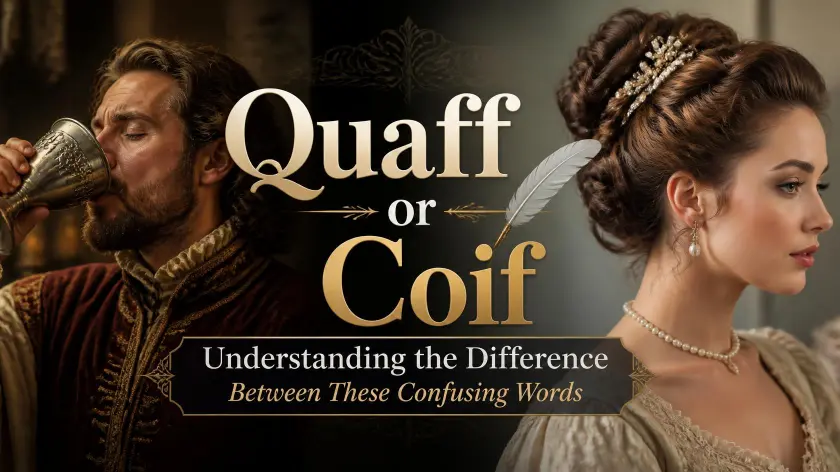
The words quaff and coif look almost identical, but their meanings are completely different. One describes an action involving drinking, while the other relates to hair or a hairstyle. Confusing these two words can change the meaning of an entire sentence.
Understanding quaff or coif is important because these words appear in literature, historical writing, fashion discussions, and formal English. Although they sound similar, they belong to different categories and are used in completely different situations.
Here’s why:
The confusion comes from their spelling. Only one letter separates them, but their origins, meanings, and uses have nothing in common.
Quaff means to drink something deeply or enthusiastically.
Coif refers to a hairstyle, a head covering, or the act of styling someone’s hair.
Knowing the difference helps you avoid embarrassing mistakes and makes your writing more precise.
The Core Rule Explained Simply
The easiest way to understand quaff vs. coif is to remember:
Quaff = drink.
Coif = hair or head covering.
If someone is enjoying a large drink, they quaff it.
Example:
- The travelers quaffed cold water after their long journey.
If someone has a carefully arranged hairstyle, they have a coif.
Example:
- The actor arrived with an elegant coif for the ceremony.
The words may look similar, but they describe completely different ideas.
One is about consumption.
The other is about appearance.
Quaff: The Drinking Word
The verb quaff means to drink heartily, quickly, or with enjoyment. It often suggests drinking a large amount or drinking with enthusiasm.
Examples:
- The guests quaffed wine during the celebration.
- The hikers quaffed fresh water after reaching the top.
- He quaffed his coffee before leaving for work.
The word is often associated with older or literary styles of writing.
Modern speakers usually say:
- Drink.
- Sip.
- Finish.
But quaff adds a more dramatic or historical feeling.
Coif: The Hair and Head Covering Word
The word coif has a completely different meaning. It can refer to a hairstyle or a type of head covering.
As a noun:
- Her beautiful coif attracted attention at the event.
As a verb:
- The stylist coifed the model’s hair before the photoshoot.
The word is often connected with formal styling, fashion, or historical clothing.
Examples:
- The bride wore an elegant coif.
- The performer’s carefully coifed hair matched the costume.
The meaning always relates to hair or something worn on the head.
Side-by-Side Comparison Table
| Situation | Example | Meaning | Correct Usage |
| Drinking enthusiastically | They quaffed the refreshing juice. | They drank it eagerly. | Use quaff |
| Drinking in literature | The warriors quaffed ale after battle. | They consumed a drink. | Use quaff |
| Hairstyle | She wore a stylish coif. | A carefully arranged hairstyle. | Use coif |
| Hair styling action | The artist coifed her hair. | Styled the hair. | Use coif |
| Historical clothing | The knight wore a protective coif. | A head covering. | Use coif |
Deep Dive Into Category 1: Understanding Quaff
The word quaff focuses entirely on drinking. It describes the way someone drinks, not just the fact that they drink.
A person does not usually quaff a tiny amount.
The word suggests enthusiasm, enjoyment, or a large quantity.
When to Use Quaff
Use quaff when describing:
- Drinking with energy.
- Drinking large amounts.
- Celebratory drinking.
- Historical or dramatic scenes.
Examples:
- The sailors quaffed their drinks after returning home.
- The crowd quaffed beverages during the festival.
- The king quaffed from a golden cup.
The word creates a strong image.
It suggests movement and enjoyment.
Compare:
“I drank the water.”
This is simple and neutral.
“I quaffed the water.”
This suggests a powerful or enthusiastic action.
Quaff in Historical Writing
The word quaff frequently appears in stories about medieval life, fantasy worlds, and historical events.
Examples:
- The warriors quaffed mead in the great hall.
- The villagers quaffed ale during the harvest celebration.
Writers use this word because it creates an old-fashioned or dramatic atmosphere.
A fantasy author might choose quaff instead of drink because it makes the scene feel more traditional.
Quaff as a Verb
Quaff is mainly used as a verb.
Common forms:
- Present: quaff
- Past: quaffed
- Present participle: quaffing
Examples:
Present:
- They quaff their favorite drinks every year.
Past:
- They quaffed their drinks after the victory.
Continuous:
- They were quaffing beverages at the party.
The spelling remains predictable.
Quick Test for Quaff
Ask yourself:
1. Is someone drinking something?
If yes, quaff may work.
Example:
“The guests ___ wine.”
Answer:
“The guests quaffed wine.”
2. Is the drinking enthusiastic or dramatic?
If yes, quaff is a strong choice.
3. Would “drink deeply” make sense?
If yes, quaff may fit.
Quick checklist:
Use quaff when:
- The sentence involves drinking.
- The action is enthusiastic.
- The style is literary or dramatic.
- You want to emphasize enjoyment.
Avoid quaff when:
- Talking about hairstyles.
- Describing clothing.
- Referring to appearance.
Deep Dive Into Category 2: Understanding Coif
The word coif belongs to the world of hair, fashion, and historical clothing.
Unlike quaff, it has nothing to do with drinking.
When to Use Coif
Use coif when discussing:
- Hairstyles.
- Hair arrangement.
- Head coverings.
- Historical protective caps.
Examples:
- The celebrity showed off a new coif.
- The stylist created a beautiful coif for the event.
- The knight wore a chainmail coif.
The meaning depends on context.
In modern usage, coif usually refers to hair.
In historical contexts, it may refer to a protective covering worn on the head.
Coif as a Hairstyle
A coif can describe carefully arranged hair.
Examples:
- The actress appeared with a dramatic coif.
- Her elegant coif matched her formal dress.
- The designer created a unique coif for the runway.
The word sounds more formal than everyday terms like:
- Hairstyle.
- Haircut.
- Look.
It is often used in fashion writing or descriptive literature.
Coif as a Verb
Coif can also be used as a verb.
To coif means to style or arrange hair.
Examples:
- The stylist coifed the performer’s hair.
- Her hair was carefully coifed before the ceremony.
The verb form describes the action of creating a hairstyle.
Common forms:
- Present: coif
- Past: coifed
- Present participle: coifing
Examples:
- The artist coifs the models’ hair.
- The artist coifed the models’ hair.
- The artist is coifing the models’ hair.
Historical Meaning of Coif
Historically, a coif was a close-fitting covering worn on the head.
It could be:
- A cloth cap.
- A protective covering.
- Part of medieval clothing or armor.
Examples:
- The soldier wore a chainmail coif under his helmet.
- The noblewoman wore a linen coif.
This older meaning appears often in historical books and documentaries.
Quick Test for Coif
Ask:
1. Is the sentence about hair?
If yes, use coif.
Example:
“The stylist created a beautiful ___.”
Answer:
“The stylist created a beautiful coif.”
2. Is the sentence about a head covering?
If yes, coif may be correct.
3. Could you replace the word with hairstyle or head covering?
If yes, coif fits.
Quick checklist:
Use coif when:
- Talking about hair.
- Describing styling.
- Discussing historical headwear.
- Writing about fashion.
Avoid coif when:
- Talking about drinking.
- Describing beverages.
- Discussing consumption.
The Meaning Shift: Quaff vs Coif
The biggest difference between quaff and coif is not pronunciation or spelling.
It is meaning.
Quaff focuses on an action.
Coif focuses on appearance or covering.
Compare:
- He quaffed the drink.
- He wore a coif.
The first sentence tells us what someone did.
The second tells us what someone wore or how someone looked.
Changing one word completely changes the image.
Example:
“The king quaffed before the celebration.”
Meaning:
The king drank before the celebration.
“The king wore a coif before the celebration.”
Meaning:
The king wore a head covering or styled his hair before the celebration.
These sentences create completely different scenes.
The words may look like twins, but they live in separate worlds.
Why the Confusion Persists
The confusion between quaff and coif exists mainly because English contains many words that look similar but have unrelated meanings.
Several factors create this problem.
Similar Spelling
The biggest issue is visual similarity.
Quaff:
Q U A F F
Coif:
C O I F
Only a few letters separate them.
When reading quickly, people may confuse one for the other.
Rare Vocabulary
Both words are less common in everyday conversations.
Most people frequently hear:
- Drink.
- Hair.
- Style.
They hear quaff and coif much less often.
Because these words are uncommon, many people rely on spelling rather than understanding.
Different Historical Origins
The words also come from different backgrounds.
Quaff developed from older Germanic influences connected with drinking.
Coif comes from Old French and originally referred to a type of head covering.
Their different histories explain why their meanings never became connected.
Pronunciation Confusion
Many speakers are unsure how to pronounce them.
Quaff is pronounced like:
“kwaf”
Coif is usually pronounced like:
“koyf”
The vowel sounds are different.
Pronunciation can help separate them.
Remember:
Quaff rhymes with “giraffe” style sounds.
Coif sounds like “coin” without the n.
Formal vs Casual Contexts
The words quaff and coif behave differently depending on the situation. Both are considered somewhat uncommon words, so their usage is often connected to specific writing styles, professional fields, or creative contexts.
In casual conversation, most people rarely say quaff or coif. Instead, they usually use simpler words.
For example:
Casual:
- He drank the juice quickly.
- She styled her hair beautifully.
More literary:
- He quaffed the refreshing drink.
- She appeared with a carefully arranged coif.
The difference is not about correctness.
It is about tone.
Quaff in Formal and Creative Writing
The word quaff often appears in:
- Historical writing.
- Fantasy novels.
- Poetry.
- Descriptive storytelling.
Example:
- The warriors quaffed their victory drinks after the battle.
This sounds dramatic because quaff adds energy to the action.
A news report would probably say:
- The players drank beverages after the celebration.
A fantasy story might say:
- The heroes quaffed their drinks inside the ancient hall.
The word creates atmosphere.
Coif in Fashion and Historical Writing
The word coif appears more often in:
- Fashion articles.
- Beauty descriptions.
- Historical discussions.
- Costume analysis.
Examples:
- The designer created an elaborate coif for the runway.
- The historical figure wore a traditional linen coif.
In everyday speech, people usually say:
- Hairstyle.
- Hairdo.
- Hair arrangement.
However, coif provides a more elegant or specialized tone.
Professional Usage
Certain industries use these words more naturally.
A historian may discuss:
- Medieval coifs.
- Armor coverings.
- Traditional clothing.
A fashion writer may describe:
- A celebrity’s coif.
- A carefully coiffed hairstyle.
A restaurant review might rarely use quaff unless the writer wants a poetic style.
Example:
- Visitors can quaff locally produced beverages.
This sounds more like creative writing than normal conversation.
Case Studies and Pop Culture Examples
Real-world examples help show how quaff and coif function naturally.
Case Study 1: Fantasy Literature
Fantasy writing often uses quaff because it creates an old-world feeling.
Imagine a scene:
“The warriors returned from battle and quaffed their drinks beside the fire.”
The word immediately creates a medieval atmosphere.
If the writer simply says:
“The warriors drank their drinks.”
The meaning remains, but the historical feeling becomes weaker.
Writers choose quaff because word choice shapes the reader’s imagination.
Case Study 2: Historical Clothing
The word coif appears frequently in discussions about medieval clothing.
For example:
“A knight wore a chainmail coif beneath his helmet.”
Here, coif refers to protective headwear.
This usage has nothing to do with hairstyles.
The context makes the meaning clear.
Case Study 3: Fashion and Beauty
Modern fashion writing may use coif to describe carefully styled hair.
Examples:
- The actress arrived with a polished coif.
- The model’s dramatic coif completed the outfit.
This usage creates a more sophisticated description.
A simple word like hair does not provide the same detail.
Advanced Scenarios and Flowchart
When deciding between quaff or coif, follow this simple process:
Start:
Is the sentence about consuming a drink?
Yes → Use **quaff**
Example: The guests quaffed wine during the celebration.
No → Continue.
Is the sentence about hair, styling, or appearance?
Yes → Use **coif**
Example: The stylist created a beautiful coif.
No → Continue.
Is the sentence about historical clothing or armor?
Yes → Use **coif**
Example: The warrior wore a chainmail coif.
No → The word may not be appropriate.
Another quick decision method:
Drink → Quaff
Hair → Coif
Head covering → Coif
Style of drinking → Quaff
Style of appearance → Coif
Quick Reference Table
| Word | Meaning | Common Context |
| Quaff | To drink deeply or enthusiastically | Literature, celebrations, historical scenes |
| Coif | A hairstyle or head covering | Fashion, beauty, history |
| Quaffed | Drank in an eager way | Past drinking actions |
| Coifed | Styled hair or wore a head covering | Hair and costume descriptions |
Common Mistakes That Lower Quality
Even experienced writers sometimes confuse quaff and coif because they look similar. These mistakes can weaken clarity and create unintended meanings.
Mistake 1: Using Coif When Talking About Drinking
Incorrect:
- The guests coifed their wine during dinner.
This suggests something related to hair, not drinking.
Correct:
- The guests quaffed their wine during dinner.
Mistake 2: Using Quaff for Hairstyles
Incorrect:
- The actress showed off her new quaff.
This spelling changes the meaning.
Correct:
- The actress showed off her new coif.
A coif describes a hairstyle.
Mistake 3: Treating Them as Pronunciation Twins
Although they look similar, they do not sound the same.
Quaff:
- Sounds like “kwaf.”
Coif:
- Sounds like “koyf.”
Correct pronunciation helps prevent confusion.
Mistake 4: Overusing These Words
Because these words sound sophisticated, writers sometimes use them unnecessarily.
Example:
- I quaffed my morning coffee.
This is grammatically possible, but it may sound exaggerated.
In everyday writing:
- I drank my morning coffee.
is usually better.
Similarly:
- She wore a new coif.
may sound formal when:
- She had a new hairstyle.
would work better.
Mistake 5: Ignoring Context
Context usually reveals the correct choice.
Example:
“The queen wore a beautiful ___.”
The answer is:
Coif.
Why?
Because queens wear hairstyles or head coverings.
“The travelers ___ water after crossing the desert.”
The answer is:
Quaffed.
Why?
Because travelers drink water.
Memory Hacks That Actually Work
Remembering quaff vs. coif becomes easier with simple connections.
Memory Hack 1: Quaff Starts With “Q” for Quantity
Think:
Quaff = Quantity of drink.
The word suggests drinking a lot or drinking enthusiastically.
Example:
- They quaffed their beverages.
The action involves consumption.
Memory Hack 2: Coif Connects to Clothing
Think:
Coif = Covering.
Both begin with a “C” idea.
A coif can cover the head.
Example:
- The knight wore a coif.
Memory Hack 3: Picture the Scene
Create two mental images:
Quaff:
A person lifting a large cup.
Coif:
A person sitting while a stylist arranges their hair.
Different pictures create different meanings.
Why Precision Matters: Authority
Using the correct word between quaff or coif matters because language accuracy affects credibility.
For SEO writers, bloggers, and content creators, word precision helps build reader trust.
A misplaced word can confuse readers.
It can also make content appear poorly researched.
For example:
Incorrect:
“The historical figure was known for her elegant quaff.”
Readers may wonder why drinking is being discussed.
Correct:
“The historical figure was known for her elegant coif.”
Now the sentence clearly refers to appearance.
Search engines reward content that provides useful, clear information.
Accurate vocabulary supports:
- Better readability.
- Stronger authority.
- Improved user experience.
- Higher content quality.
When writing about history, fashion, food, or literature, choosing the right word shows expertise.
Small vocabulary differences create big improvements in professional writing.
A Quick Quiz
Fill in the blanks with quaff or coif.
1. The travelers stopped to ______ cold water after the long journey.
2. The actress arrived with an elegant ______ at the awards ceremony.
3. The medieval knight wore a protective chainmail ______.
4. The guests ______ their drinks during the celebration.
5. The stylist carefully ______ the model’s hair before the show.
6. The fantasy heroes gathered in the hall to ______ their beverages.
7. The designer created a unique ______ for the fashion event.
Answers
- The travelers stopped to quaff cold water after the long journey.
- The actress arrived with an elegant coif at the awards ceremony.
- The medieval knight wore a protective chainmail coif.
- The guests quaffed their drinks during the celebration.
- The stylist carefully coifed the model’s hair before the show.
- The fantasy heroes gathered in the hall to quaff their beverages.
- The designer created a unique coif for the fashion event.
Conclusion: Quaff or Coif
The difference between quaff and coif is simple once you focus on their meanings and contexts. Quaff relates to drinking, especially drinking with enthusiasm, enjoyment, or in a dramatic way. Coif relates to hair, hairstyles, or historical head coverings. Although these words look similar, they belong to completely different categories of language. Remembering the connection between quaff and thirst and coif and covering can help you avoid confusion. Using the correct word improves clarity, strengthens your vocabulary, and helps your writing sound more accurate and professional.
Mastering uncommon word pairs like quaff or coif improves your overall command of English. These words often appear in literature, historical writing, fashion discussions, and creative descriptions. Choosing the right word allows readers to understand your exact meaning without confusion. Whether you are describing a medieval celebration, a stylish hairstyle, or a formal piece of writing, vocabulary precision matters. A strong writer does not just know many words; they know when and where each word belongs. With the right memory tricks and practice, quaff and coif become easy to recognize and use correctly.
Frequently Asked Questions
What is the main difference between quaff and coif?
The main difference between quaff and coif is their meaning. Quaff is a verb that means to drink something deeply or enthusiastically. Coif can be a noun referring to a hairstyle or head covering, or a verb meaning to style hair. They may look similar, but they describe completely different actions and objects.
Is quaff related to drinking?
Yes, quaff is directly related to drinking. It describes the act of consuming a beverage with enthusiasm, enjoyment, or in a large amount. The word often appears in historical stories, fantasy writing, and literary descriptions. For example, a writer might say that travelers quaffed water after a difficult journey.
What does coif mean?
Coif has two main meanings. In modern usage, it usually refers to a carefully arranged hairstyle. Historically, it referred to a close-fitting head covering worn as part of clothing or armor. For example, a stylist may create a beautiful coif, while a medieval soldier may wear a protective coif beneath a helmet.
Are quaff and coif pronounced the same?
No, quaff and coif have different pronunciations. Quaff is pronounced like “kwaf,” while coif is generally pronounced like “koyf.” Their similar spelling can confuse, but their sounds and meanings are different. Learning their pronunciation can make it easier to identify which word belongs in a sentence.
Can quaff be used in everyday conversation?
Technically, yes, but quaff is uncommon in everyday speech. Most people simply use words like drink, sip, or consume. Quaff is more common in creative writing, historical descriptions, and situations where the writer wants to create a dramatic or old-fashioned tone.
Can coif describe a hairstyle?
Yes, coif can describe a hairstyle. It often suggests a carefully arranged, elegant, or formal hairstyle rather than an ordinary haircut. Fashion writers and stylists may use the word when describing a distinctive appearance. For example, someone attending a formal event might wear an elaborate coif.
Why do people confuse quaff and coif?
People confuse quaff and coif because they have similar spelling and contain many of the same letters. However, their origins and meanings are unrelated. One word focuses on drinking, while the other focuses on hair or head coverings. Remembering the subject area of each word prevents most mistakes.
Is coif still commonly used today?
Coif is not extremely common in everyday conversation, but it still appears in specific fields. It is used in fashion writing, historical discussions, costume descriptions, and literary works. In normal speech, people usually say hairstyle or hairdo instead. However, coif remains useful when a more formal or descriptive word is needed.
Is quaff always used for alcoholic drinks?
No, quaff is not limited to alcoholic drinks. Although it is often associated with wine, ale, or historical celebrations, it can describe drinking many types of beverages. Someone can quaff water, juice, or another drink if the action is enthusiastic or done in a large amount.
How can I easily remember quaff and coif?
A simple way to remember them is to connect quaff with thirst and coif with covering. Quaff involves drinking and satisfying thirst. Coif involves hair or something that covers the head. These mental connections make the two words easier to separate when writing or reading.

Caroline Stewart is a dedicated writer and English language enthusiast who enjoys making everyday English easier to understand. At Grammarzcore, she creates clear, practical content covering grammar, word meanings, sentence usage, and common language questions. Her goal is to turn confusing English topics into simple, useful explanations that readers can apply with confidence. Caroline writes for students, professionals, and anyone looking to strengthen their English skills and communicate more naturally, accurately, and effectively in everyday life.