
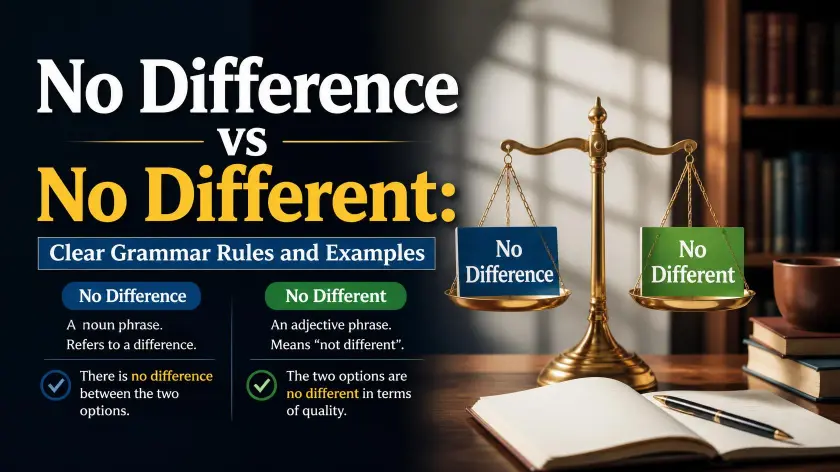
The phrases “no difference” and “no different” look almost identical, but they serve completely different grammatical purposes. Many English learners and even native speakers confuse them because both expressions compare two things and suggest similarity.
Understanding no difference vs no different helps you choose the correct phrase in conversations, writing, and professional communication. One phrase describes a lack of change or distinction, while the other describes two things that are the same or similar in nature.
The key is simple:
“No difference” is a noun phrase.
“No different” is an adjective phrase.
Once you understand what each phrase describes, choosing the right option becomes much easier.
Here’s why:
The word that comes after “no” determines the grammar. Difference is a noun, while different is an adjective. The sentence structure decides which one belongs.
The Core Rule Explained Simply
The difference between “no difference” and “no different” comes down to the role each phrase plays.
A noun names a person, place, thing, or idea.
Examples:
- difference
- change
- opinion
- result
An adjective describes a noun.
Examples:
- different
- similar
- unusual
- important
So:
No difference = no distinction exists.
Example:
There is no difference between these two products.
This means the products are the same in some important way.
No different = not different from something else.
Example:
This product is no different from the previous version.
This means the product is similar to the previous version.
The meanings are closely related, but the grammar is different.
Let’s make this concrete.
Compare:
There is no difference between the two answers.
The focus is on the absence of a difference.
The two answers are no different from each other.
The focus is on the fact that they are the same.
Both sentences communicate similarity, but they use different structures.
The Two Primary Rules Explained
Rule 1: Use “No Difference” to Talk About Absence of Change
Use “no difference” when you are talking about a missing distinction between two or more things.
The phrase usually appears after verbs like:
- is
- was
- makes
- shows
- finds
- sees
Examples:
There is no difference between the two methods.
The sentence says that the methods have no noticeable distinction.
I noticed no difference after changing the settings.
The sentence says the change produced no result.
The test showed no difference between the groups.
The results were the same.
The focus is not describing the things directly. It is describing the relationship between them.
Rule 2: Use “No Different” to Describe Similarity
Use “no different” when you want to say that something is not different from another thing.
This phrase usually works with:
- from
- than
Examples:
This version is no different from the original.
Meaning:
This version is the same as the original in important ways.
Her experience was no different than mine.
Meaning:
Her experience was similar to mine.
The structure usually looks like this:
Subject + is/was + no different + from/than + comparison
Examples:
The new system is no different from the old one.
His reaction was no different than expected.
The phrase describes the subject.
Side-by-Side Comparison Table
| Situation | Example | Meaning | Correct Usage |
| Talking about absence of a distinction | There is no difference between the options. | The options are not different. | No difference |
| Describing similarity | The options are no different from each other. | The options are the same. | No different |
| Discussing results | The experiment showed no difference. | No change occurred. | No difference |
| Comparing two things | This model is no different from the older one. | This model is similar. | No different |
| Explaining a lack of impact | The update made no difference. | The update changed nothing. | No difference |
Deep Dive Into Category 1: Using “No Difference”
“No difference” focuses on the idea of equality, sameness, or lack of change.
The phrase treats “difference” as a thing that does not exist.
Think of it like this:
Difference = a gap between two things.
No difference = no gap exists.
For example:
There is no difference between these two phones.
The sentence does not describe either phone directly. It describes the relationship between them.
When to Use “No Difference”
Use “no difference” when answering questions like:
- Is there any change?
- Is there any distinction?
- Did something affect the result?
- Are two outcomes separated in any way?
Examples:
There is no difference between the two recipes.
The recipes have the same result.
The new design made no difference.
The design change had no effect.
Researchers found no difference in performance.
The groups performed similarly.
Common Sentence Patterns With “No Difference”
Pattern 1:
There is/was no difference between + two things
Examples:
There is no difference between these brands.
There was no difference between the first and second attempts.
This is one of the most common uses.
Pattern 2:
Make no difference
This means something does not affect the result.
Examples:
The small mistake made no difference.
Your choice will make no difference to the final outcome.
The phrase means the result stays unchanged.
Pattern 3:
Notice/see/find no difference
These phrases describe someone observing no change.
Examples:
I can see no difference between the images.
The doctor found no difference in the results.
Quick Test for “No Difference”
Ask yourself:
Am I talking about a lack of change or distinction?
If yes, use no difference.
Try this:
“There is ______ between these two choices.”
The answer is:
“There is no difference between these two choices.”
Another test:
Can you replace it with:
“no change” or “no distinction”?
If yes, no difference is likely correct.
Example:
“The update caused no difference.”
“The update caused no change.”
The meaning stays similar.
Deep Dive Into Category 2: Using “No Different”
“No different” focuses on comparison.
It explains that one thing is similar to another thing.
Unlike “no difference,” this phrase describes a person, object, situation, or experience.
Think of it like this:
Different = not the same.
No different = the same or similar.
Example:
The new policy is no different from the old policy.
The subject is the new policy.
The phrase describes its relationship to the old policy.
When to Use “No Different”
Use “no different” when comparing one thing with another.
Examples:
This problem is no different from the others.
Her opinion is no different from mine.
The experience was no different than expected.
The phrase often answers:
How is this thing compared to another thing?
Common Sentence Patterns With “No Different”
Pattern 1:
Subject + be + no different from + comparison
Examples:
The new phone is no different from the previous model.
His answer is no different from yours.
This is the clearest and most standard pattern.
Pattern 2:
Subject + be + no different than + comparison
Examples:
The result was no different than before.
The situation is no different than last year.
This version is common in everyday American English, though some style guides prefer “from.”
Quick Test for “No Different”
Ask:
Am I describing something by comparing it to another thing?
If yes, use no different.
Example:
“This restaurant is ______ the one we visited yesterday.”
Correct:
“This restaurant is no different from the one we visited yesterday.”
The phrase needs a comparison.
A helpful clue:
If you can add “from something” after the phrase, “no different” may be the right choice.
The Meaning Shift: Understanding the Small Difference
The difference between “no difference” and “no different” is subtle because both expressions often communicate the idea of similarity. However, the focus changes depending on which phrase you choose.
“No difference” focuses on the result.
It tells you that two things have no noticeable gap, change, or distinction.
Example:
There is no difference between the two plans.
The sentence focuses on the absence of a difference.
“No different” focuses on the comparison.
It tells you that one thing matches or resembles another thing.
Example:
The new plan is no different from the old one.
The sentence focuses on how the new plan compares with the old plan.
Here is another way to see the difference:
No difference asks: “What is the gap?”
Answer:
There is no gap.
No different asks: “How does this compare?”
Answer:
It compares the same way as something else.
Both phrases can describe similarity, but they approach the idea from different directions.
Consider these examples:
There is no difference between online classes and traditional classes.
The sentence highlights the absence of a difference.
Online classes are no different from traditional classes.
The sentence highlights the similarity between the two types of classes.
The meaning is close, but the grammatical focus changes.
Why the Confusion Persists
The confusion around no difference vs no different happens because English learners often focus on meaning rather than grammar. Since both expressions suggest that two things are similar, people assume they can be exchanged freely.
However, English depends heavily on word categories.
Difference is a noun.
It names the idea of separation or distinction.
Different is an adjective.
It describes something that is not the same.
This small grammatical difference creates different sentence structures.
Many people also confuse these phrases because everyday speech often allows flexible wording. A speaker might say:
There is no different between the two options.
The meaning may be understandable, but the grammar is incorrect.
The correct sentence is:
There is no difference between the two options.
Another common mistake is:
The two options have no different.
The correct version is:
The two options are no different.
The reason is simple:
You cannot use an adjective where a noun is required.
Education gaps also contribute to the confusion. Many grammar lessons focus on vocabulary meanings but do not explain how words function in sentences.
The solution is to identify the role of the word:
Need a thing or idea? Use difference.
Need a description? Use different.
Formal vs Casual Contexts
The choice between “no difference” and “no different” remains the same in both formal and casual situations. The grammar rule does not change based on the audience.
However, the frequency of each phrase may vary.
In professional writing, “no difference” is often common because it appears in reports, research, and comparisons.
Examples:
The study found no difference between the two groups.
The analysis showed no difference in customer satisfaction.
These sentences sound natural in academic and business settings.
The phrase “no different” is also acceptable but is often more conversational.
Examples:
The new process is no different from the previous one.
His reaction was no different from what we expected.
In formal writing, some editors prefer more direct alternatives.
Instead of:
The results are no different from last year.
A report might say:
The results are identical to last year’s findings.
However, “no different” is still grammatically correct.
The key is not avoiding one phrase. It is using the correct phrase for your sentence structure.
Case Studies and Real-World Examples
Seeing these phrases in realistic situations makes the difference easier to remember.
Case Study 1: Technology Comparisons
Imagine a company releases a new smartphone.
Example:
There is no difference between the old phone and the new phone.
This means testing showed no meaningful change.
Another example:
The new phone is no different from the previous model.
This means the new phone is similar to the old one.
The first sentence focuses on the result.
The second sentence focuses on comparison.
Case Study 2: Academic Research
Researchers often compare groups.
Example:
The researchers found no difference between the control group and the test group.
This means the results were statistically similar.
A researcher could also write:
The test group was no different from the control group.
This describes the test group by comparing it with the other group.
Both sentences can work, depending on the intended focus.
Case Study 3: Everyday Conversations
Imagine someone asks whether two restaurants are different.
You could say:
There is no difference between the two restaurants.
This suggests they are equally good, similar, or identical in some way.
You could also say:
The second restaurant is no different from the first one.
This compares the second restaurant directly with the first.
Case Study 4: Workplace Communication
A manager may discuss two approaches.
Example:
The new strategy made no difference.
Meaning:
The strategy did not change the outcome.
Another example:
The new strategy is no different from the previous one.
Meaning:
The strategy is basically the same as before.
The situation is similar, but the emphasis changes.
Advanced Scenarios and Flowchart
Use this decision process when choosing between the two phrases.
Start with your sentence.
|
v
Are you talking about a lack of change, result, or distinction?
|
Yes
|
v
Use “no difference.”
|
Example:
The experiment showed no difference.
|
No
|
v
Are you describing one thing by comparing it to another?
|
Yes
|
v
Use “no different.”
|
Example:
This version is no different from the original.
|
Still unsure?
|
v
Check the word after “no.”
|
Need a noun?
Use “difference.”
|
Need an adjective?
Use “different.”
This simple flow helps you make the correct choice quickly.
Quick Reference Table
| Phrase | Main Function | Example |
| No difference | Shows no change or distinction exists | There is no difference between the results. |
| No different | Describes similarity between two things | This result is no different from the previous one. |
Common Mistakes That Lower Quality
Even strong English speakers sometimes misuse these phrases.
Mistake 1: Using “No Different” as a Noun
Incorrect:
There is no different between the options.
Why?
Because “different” is not a noun.
Correct:
There is no difference between the options.
Mistake 2: Using “No Difference” to Describe Something
Incorrect:
The new version is no difference from the old one.
Why?
The sentence needs an adjective to describe the version.
Correct:
The new version is no different from the old one.
Mistake 3: Forgetting the Comparison After “No Different”
Incorrect:
The new system is no different.
This sentence can be correct if the comparison is understood from context.
However, clearer writing usually includes the comparison.
Better:
The new system is no different from the previous system.
Mistake 4: Confusing “Different” and “Difference”
A useful reminder:
Difference = thing
Example:
I noticed a difference.
Different = description
Example:
The results are different.
Adding “no” does not change their basic roles.
Mistake 5: Choosing Based Only on Meaning
Many people think:
“They both mean the same, so either one works.”
That is not true.
Grammar determines the correct choice.
The sentence structure decides whether you need a noun or adjective.
Memory Hacks That Actually Work
Learning these phrases becomes easier when you connect them to simple ideas.
Hack 1: Remember “Difference Is a Thing”
Ask:
Can I count or notice it?
Examples:
A difference exists.
A difference appears.
A difference matters.
Therefore:
No difference = no thing exists.
Hack 2: Remember “Different Describes”
Ask:
Am I describing something?
Examples:
The car is different.
The experience is different.
The result is different.
Therefore:
No different = a description of similarity.
Hack 3: Look at the Verb
After:
There is/was
You often need:
no difference
Example:
There is no difference between them.
After:
is/was + comparison
You often need:
no different
Example:
It is no different from before.
Hack 4: Use the Replacement Trick
Replace:
no difference with no change
Example:
The update caused no change.
Correct:
The update caused no difference.
Replace:
no different with the same as
Example:
The new version is the same as the old one.
Correct:
The new version is no different from the old one.
Why Precision Matters (SEO and Authority)
Correct word choice matters because small grammar details influence how readers judge content quality. In online writing, especially SEO content, clarity and accuracy help establish trust.
A reader may not always identify a grammar mistake consciously, but awkward wording can affect their confidence in the information.
Using “no difference” and “no different” correctly shows strong language control.
For content creators, bloggers, educators, and businesses, precise wording supports authority.
High-quality writing:
- Communicates ideas clearly
- Reduces reader confusion
- Builds credibility
- Creates a professional impression
Search engines value helpful content that answers questions naturally. Clear grammar improves user experience because readers can understand information without distractions.
Grammar is not just about rules. It is about making communication effective.
A Quick Quiz
Fill in the blanks with no difference or no different.
- There is ______ between these two methods.
- The new design is ______ from the original version.
- The test results showed ______ between the groups.
- Her experience was ______ from mine.
- The price change made ______ to the final result.
- This situation is ______ from what happened last year.
- Researchers found ______ in the performance levels.
- The updated software is ______ from the previous release.
Answers
- There is no difference between these two methods.
- The new design is no different from the original version.
- The test results showed no difference between the groups.
- Her experience was no different from mine.
- The price change made no difference to the final result.
- This situation is no different from what happened last year.
- Researchers found no difference in the performance levels.
- The updated software is no different from the previous release.
Conclusion
Understanding “no difference” vs no different becomes simple when you focus on the role each phrase plays in a sentence. “No difference” refers to the absence of a change, distinction, or separation between things. “No different” describes something that is similar to another thing through comparison. Although the meanings are closely connected, the grammar behind them is different. Remembering that difference is a noun and different is an adjective gives you a reliable way to choose the correct phrase. With practice, this common grammar confusion becomes much easier to avoid.
Using the right expression improves clarity in both everyday conversations and professional writing. Whether you are creating content, preparing a report, or communicating at work, accurate word choices help your message sound more natural and trustworthy. Instead of choosing between “no difference” and “no different” based only on meaning, examine the sentence structure. Ask whether you are discussing a missing distinction or describing a comparison. This small grammar habit can strengthen your writing and help you communicate ideas with greater precision.
Frequently Asked Questions
What is the main difference between “no difference” and “no different”?
The main difference is grammar and sentence function. “No difference” uses a noun and means that no distinction or change exists. “No different” uses an adjective and means something is similar to another thing. For example, “There is no difference between the options” focuses on the absence of change, while “This option is no different from the others” focuses on comparison.
Can “no difference” and “no different” mean the same thing?
Sometimes they communicate a similar idea, but they are not interchangeable. Both can suggest that two things are alike, but the focus changes. “No difference” highlights the lack of a gap or change, while “no different” describes one thing as similar to another. The correct choice depends on how the sentence is structured.
Is “there is no different between them” correct?
No, this sentence is incorrect in standard English. The word different is an adjective, so it cannot be used as the noun in this structure. The correct sentence is “There is no difference between them.” Since the sentence needs a thing or concept, the noun “difference” is required.
When should I use “this is no different from”?
Use “this is no different from” when comparing one situation, object, or experience with another. For example, “This process is no different from the previous one” means the process is similar to what came before. The phrase describes the subject by showing its relationship to another example.
Is “no difference” common in formal writing?
Yes, “no difference” is very common in formal writing, especially in research, business, and analytical contexts. Writers often use it when discussing results, comparisons, or outcomes. For example, a study might say, “The researchers found no difference between the two groups,” meaning the results showed no meaningful variation.
Which phrase should I use after “there is”?
In most cases, use “no difference” after “there is” or “there was.” The structure usually describes the existence or absence of something. For example, “There is no difference between these products” is correct because “difference” is the thing that does not exist.
Can “no different” be used without saying “from”?
Yes, “no different” can sometimes appear without “from” when the comparison is already clear from context. For example, someone might say, “The new version is no different.” However, adding the comparison usually makes the sentence clearer, such as “The new version is no different from the old one.”
Why do people confuse “no difference” and “no different”?
People often confuse them because both phrases express similarity. The words look nearly identical, and many speakers focus only on the meaning rather than the grammar. Learning that difference is a noun and different is an adjective helps separate the two and prevents common mistakes.
Is “no different than” acceptable English?
Yes, “no different than” is widely used, especially in American English. However, some grammar guides prefer “no different from” because “from” traditionally introduces comparisons. Both forms are understood, but “no different from” is often considered the safer choice in formal writing.
How can I quickly remember which phrase to use?
Think of difference as a thing and different as a description. If you are talking about a missing thing, use “no difference.” If you are describing how something compares, use “no different.” This simple memory trick works in most everyday sentences.

Grace Walker is a passionate writer and English language enthusiast who enjoys making everyday English clear, practical, and easy to understand. At Grammarzcore, she creates helpful content about grammar, word meanings, sentence usage, and common language questions. Her writing turns confusing topics into simple explanations that readers can use with confidence. Grace aims to help students, professionals, and everyday learners communicate more clearly, naturally, and effectively while developing a stronger understanding of the English language through useful, engaging, and reliable guidance.