
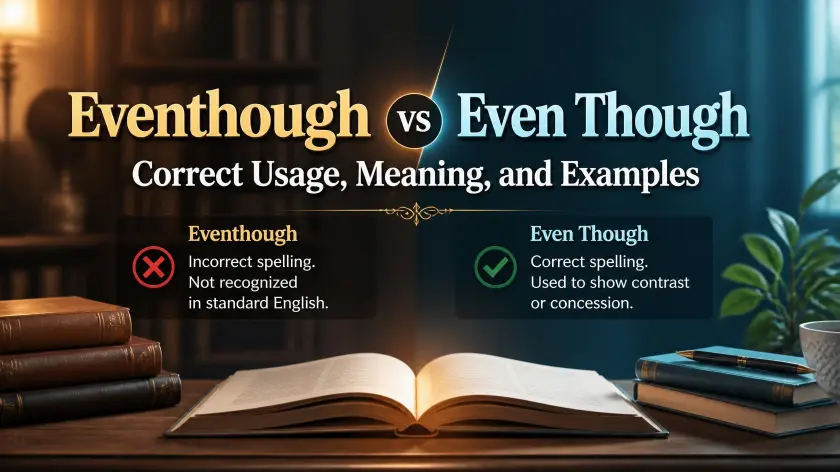
Many people are confused about whether “eventhough” is an acceptable spelling or whether the words should always be written separately. This confusion is especially common in English writing, where small spelling differences can affect grammar accuracy and clarity.
The answer is simple: “even though” is the correct form, while “eventhough” is considered incorrect in standard English. Understanding eventhough vs even though helps you recognize the correct two-word form and use it confidently in professional writing, academic communication, and everyday English. The phrase “even though” is a conjunction used to introduce a contrast, unexpected result, or surprising situation.
In this guide, you will learn the rule behind “even though,” why people confuse it with “eventhough,” how to use it correctly, and how to avoid common mistakes.
The Core Rule Explained Simply
The basic rule is straightforward:
“Even though” is always written as two separate words.
It functions as a subordinating conjunction, which means it connects two parts of a sentence where one idea contrasts with another.
Example:
- Even though it was raining, we went outside.
The sentence contains two contrasting ideas:
- It was raining.
- We went outside.
The phrase “even though” shows that the rain was an obstacle, but it did not stop the action.
The spelling “eventhough” does not exist as a standard English word. It is usually a spelling mistake caused by the way people pronounce the phrase quickly.
Here’s why:
Many English expressions combine over time. Speakers often shorten sounds when talking, and this can create confusion when writing.
For example:
- “a lot” is often mistakenly written as “alot.”
- “every day” is sometimes confused with “everyday.”
- “even though” is sometimes incorrectly combined into “eventhough.”
The pronunciation may sound connected, but the spelling remains separate.
The Two Primary Sides of the Topic
Side 1: Even Though, The Correct Expression
Even though is the accepted spelling in English. It introduces a condition or fact that contrasts with another statement.
Examples:
- Even though she was tired, she finished her work.
- Even though the movie was long, everyone enjoyed it.
- Even though he apologized, the problem continued.
The phrase means something similar to:
- Although
- Despite the fact that
- In spite of the fact that
Example:
- Even though he was nervous, he gave the speech.
Similar meaning:
- Although he was nervous, he gave the speech.
Side 2: Eventhough, The Incorrect Spelling
Eventhough is not recognized as a correct English word.
It should not appear in:
- School assignments
- Professional emails
- Articles
- Reports
- Formal writing
Incorrect:
- Eventhough I studied, I failed the test.
Correct:
- Even though I studied, I failed the test.
The mistake happens because English speakers often hear connected sounds rather than individual words.
Side-by-Side Comparison Table
| Situation | Example | Meaning | Correct Usage |
| Showing contrast | Even though it was late, she continued working. | A surprising action happened despite a condition. | Use even though |
| Formal writing | Even though the results were unexpected, the research continued. | Shows logical contrast. | Use two words |
| Casual conversation | Even though I was busy, I answered the call. | Explains an exception. | Use two words |
| Incorrect spelling | Eventhough I was tired, I finished. | Not a standard English form. | Avoid completely |
Deep Dive Into Category 1: Understanding Even Though
When to Use Even Though
Use even though when you want to introduce a fact that makes the second part of the sentence unexpected.
The structure is:
Even though + situation, result
Examples:
- Even though the task was difficult, she completed it.
- Even though he had little experience, he performed well.
- Even though the weather was cold, they played outside.
The first part creates an expectation.
The second part breaks that expectation.
Let’s make this concrete.
Sentence:
“Even though John was nervous, he spoke confidently.”
Normally, nervousness may prevent confident speaking. However, John did something unexpected.
That contrast is the reason we use even though.
Sentence Patterns With Even Though
Pattern 1: Even Though at the Beginning
This is one of the most common structures.
Formula:
Even though + clause, main clause
Examples:
- Even though the store was crowded, we found what we needed.
- Even though she disagreed, she supported the decision.
- Even though the project was challenging, the team succeeded.
A comma usually separates the two clauses when even though starts the sentence.
Pattern 2: Even Though in the Middle
You can also place even though after the main idea.
Formula:
Main clause + even though + contrasting clause
Examples:
- We went hiking even though the weather was uncertain.
- She accepted the offer even though the salary was lower.
- They continued the meeting even though everyone was tired.
In this position, a comma is usually not needed before even though.
Quick Test for Even Though
Use this checklist:
Can you replace it with “although”?
If yes, even though is probably correct.
Example:
- Even though it was expensive, I bought it.
Replace:
- Although it was expensive, I bought it.
The meaning stays similar.
Another test:
Does the sentence contain a contrast?
Yes:
- He was sick, but he went to work.
Correct:
- Even though he was sick, he went to work.
No contrast:
- He went to work because he had a meeting.
Do not use even though there.
Deep Dive Into Category 2: Why Eventhough Appears
Why People Write Eventhough
The incorrect spelling eventhough exists because English pronunciation often blends words together.
When people say:
“even though”
the sounds flow quickly:
“eventhough”
However, spoken language and written language do not always follow the same patterns.
Examples:
People say:
- “gonna” instead of “going to”
- “wanna” instead of “want to”
But formal writing still uses:
- going to
- want to
The same idea applies to even though.
Common Places Where Eventhough Appears
The incorrect form often appears in:
- Social media posts
- Informal messages
- Online comments
- Fast typing situations
- Beginner English writing
Example:
Incorrect:
“Eventhough I was late, I joined the class.”
Correct:
“Even though I was late, I joined the class.”
The correction is simple, but it improves writing quality.
The Meaning Shift or Nuance
Although eventhough is incorrect, some learners think it may have a different meaning from even though.
It does not.
There is no separate meaning.
The only difference is:
Even though = correct spelling
Eventhough = spelling mistake
The phrase expresses:
- Contrast
- Unexpected results
- Surprising situations
- Conditions that do not prevent something
Examples:
- Even though the road was difficult, they continued.
- Even though she was afraid, she tried.
The phrase highlights the idea that one fact exists despite another fact.
Why the Confusion Persists
The confusion between eventhough vs even though continues for several reasons.
Pronunciation Creates Confusion
English speakers often connect words while speaking.
For example:
“Even though”
can sound like one unit.
New learners may assume that if words sound connected, they should be written together.
However, spelling rules do not always follow pronunciation.
Similar English Words Cause Problems
English has many examples where spacing changes meaning.
Examples:
- Everyday vs every day
- Alright vs all right
- Maybe vs may be
Because some word combinations become single words over time, learners may assume eventhough follows the same pattern.
Online Writing Habits
Digital communication encourages speed.
People often type quickly and ignore spelling.
Repeated exposure to incorrect forms can make them appear acceptable.
However, frequent use does not make an incorrect spelling correct.
Formal vs Casual Contexts
The phrase even though works in both formal and casual situations.
The spelling never changes.
Formal Examples
Academic writing:
- Even though the experiment produced positive results, further research is necessary.
Business writing:
- Even though the deadline was extended, the team completed the project early.
Professional communication:
- Even though the issue was unexpected, we found an effective solution.
Casual Examples
Conversation:
- Even though I was tired, I watched the entire movie.
Text message:
- Even though it was raining, we had fun.
The difference is not the phrase itself. The difference is the surrounding language.
Case Studies / Pop Culture Examples
Understanding even though becomes easier when looking at how it appears in real communication. Writers, speakers, and creators use this phrase frequently because it clearly shows contrast between expectations and outcomes.
Here’s why.
A character in a story might face a difficult situation but continue forward.
Example:
“Even though the hero had no special abilities, he protected his community.”
The sentence creates contrast:
- The hero lacked an advantage.
- The hero still achieved something important.
This structure creates emotional impact because the reader understands that success happened despite difficulty.
Academic Example
Researchers often use even though to explain unexpected findings.
Example:
“Even though the sample size was small, the results showed an important pattern.”
The phrase helps readers understand that a limitation existed, but a meaningful result still appeared.
Workplace Example
Professionals use even though to discuss challenges and achievements.
Example:
“Even though the project faced several delays, the team delivered excellent results.”
The sentence acknowledges a problem while highlighting success.
Everyday Example
People naturally use even though when explaining choices.
Examples:
- Even though I was busy, I helped my friend.
- Even though the restaurant was expensive, the food was worth it.
- Even though she disliked the weather, she enjoyed the trip.
These examples show that the phrase is common in everyday English.
Advanced Scenarios & Flowchart
Sometimes choosing the right conjunction can feel confusing. This simple flowchart helps you decide when to use even though.
Use this decision process:
Start with your sentence.
Ask: Are you showing a contrast between two ideas?
|
Yes
|
Ask: Does one fact make the other fact surprising?
|
Yes
|
Use “even though.”
Example:
Even though he was tired, he finished the assignment.
No
|
Ask: Are you explaining a reason?
|
Yes
|
Use “because.”
Example:
He finished the assignment because it was important.
No
|
Ask: Are you showing a condition?
|
Yes
|
Consider “if.”
Example:
If he finishes early, he can leave.
No
|
Choose another suitable connector.
Quick Reference Table
| Expression | Meaning | Example |
| Even though | Shows contrast or unexpected results | Even though it was difficult, she succeeded. |
| Although | Similar to even though, slightly more formal | Although the plan changed, we continued. |
| Despite | Shows contrast followed by a noun or -ing form | Despite the rain, they played. |
| Because | Shows a reason | She stayed because she was interested. |
| If | Shows a condition | If it rains, we will stay inside. |
| Eventhough | Incorrect spelling | Do not use this form. |
Common Mistakes That Lower Quality
Even experienced writers sometimes make mistakes with contrast phrases. Understanding these errors helps improve accuracy.
Mistake 1: Writing Eventhough as One Word
Incorrect:
- Eventhough the task was hard, he finished it.
Correct:
- Even though the task was hard, he finished it.
This is the biggest mistake connected to this phrase.
Mistake 2: Using Even Though Without Contrast
Incorrect:
- Even though I went to the store, I bought milk.
The sentence does not create a clear contrast.
Better:
- Even though I was tired, I went to the store.
The tiredness creates the unexpected contrast.
Mistake 3: Confusing Even Though With Because
These phrases have opposite purposes.
Even though introduces contrast.
Because introduces a reason.
Compare:
- Even though it was cold, they went swimming.
- They went swimming because it was hot.
The first sentence shows an unexpected action.
The second sentence explains a reason.
Mistake 4: Using Even Though and But Together
Incorrect:
- Even though she was tired, but she continued working.
The word but is unnecessary because even though already creates contrast.
Correct:
- Even though she was tired, she continued working.
Or:
- She was tired, but she continued working.
Mistake 5: Forgetting the Comma Placement
When even though begins the sentence, use a comma after the first clause.
Correct:
- Even though the movie was long, we enjoyed it.
Incorrect:
- Even though the movie was long we enjoyed it.
When the phrase appears in the middle, a comma is usually not needed.
Correct:
- We enjoyed the movie even though it was long.
Memory Hacks That Actually Work
Remembering the correct spelling is easier with simple tricks.
Memory Hack 1: Think of “Even” and “Though” as Separate Ideas
The phrase contains two independent words:
Even + Though
Think:
“Even this situation, though that situation.”
The separation reminds you not to combine them.
Memory Hack 2: Replace It With Although
If you can replace the phrase with although, write:
even though
Example:
- Even though she was nervous, she spoke clearly.
Replace:
- Although she was nervous, she spoke clearly.
The sentence still works.
Memory Hack 3: Remember That Common Phrases Stay Separate
Many conjunction phrases contain multiple words:
- As soon as
- Even if
- Even though
- As long as
- So that
They are not combined into single words.
Memory Hack 4: Notice the Word “Though”
The word though already exists by itself.
When it appears with even, it remains separate.
Examples:
- Even though
- Even if
- Even when
These combinations keep their spaces.
Why Precision Matters (SEO/Authority)
Correct grammar builds trust.
When readers see accurate language, they are more likely to view the writer as knowledgeable and reliable.
This matters especially in:
- SEO content
- Professional websites
- Educational articles
- Business communication
- Marketing materials
A spelling mistake like eventhough may seem small, but repeated grammar errors can affect credibility.
Search engines and readers both value quality content. Clear writing improves:
Readability
Correct grammar helps readers understand information faster.
Professional Image
Businesses and creators appear more trustworthy when their content is polished.
Authority
Accurate language shows attention to detail.
For SEO writers, grammar mistakes can reduce the perceived quality of an article. A well-written page keeps users engaged longer because the information feels reliable and easy to follow.
A Quick Quiz
Fill in the blanks with the correct answer.
1. ______ it was raining, they continued the outdoor event.
Answer: __________
2. Is “eventhough” a correct English spelling?
Answer: __________
3. She finished the race ______ she was exhausted.
Answer: __________
4. Which phrase shows contrast, “even though” or “because”?
Answer: __________
5. Correct the sentence:
“Eventhough he was nervous, he gave the presentation.”
Answer: __________
6. Complete the sentence:
“Even though the book was expensive, ______.”
Answer: __________
7. Can “even though” and “but” be used together in the same sentence?
Answer: __________
8. Replace “even though” with a similar word:
“Even though she was late, she joined the meeting.”
Answer: __________
Conclusion
The difference between eventhough vs even though comes down to one simple rule: “even though” is always written as two separate words, while “eventhough” is an incorrect spelling. Although the mistake is common because the phrase sounds connected when spoken, correct written English keeps both words separate. Understanding this small grammar point helps writers create clearer sentences, avoid unnecessary errors, and communicate ideas more professionally. Whether you are writing an essay, article, email, or everyday message, using even though correctly shows strong attention to detail and improves the overall quality of your writing.
Mastering phrases like even though may seem like a small achievement, but these details build stronger language skills over time. The phrase is useful because it helps express contrast, unexpected results, and situations where one fact does not prevent another action. By remembering that even though works like although and should never be combined into one word, you can avoid a frequent spelling mistake. Good writing is built from many small choices, and choosing the correct form of common expressions helps you sound more confident, accurate, and professional in every type of communication.
Frequently Asked Questions
Is eventhough a real word in English?
No, eventhough is not a standard English word. It is considered an incorrect spelling of the phrase even though. Many people write it this way because the two words often blend together in speech, but formal and correct written English always keeps them separate.
What is the correct spelling, eventhough or even though?
The correct spelling is even though. It should always contain a space between “even” and “though.” The phrase functions as a conjunction that connects two contrasting ideas, such as “Even though it was difficult, she completed the task.”
Why do people write eventhough instead of even though?
People often write eventhough because spoken English naturally connects words together. When people say “even though” quickly, the sounds may appear like one word. However, pronunciation does not always determine spelling, and English keeps many commonly used phrases separated.
What does even though mean?
Even though means “despite the fact that” or “although.” It introduces a contrast between two ideas. For example, “Even though he was tired, he finished the project” means his tiredness existed, but it did not stop him from completing the work.
Can even though be replaced with although?
Yes, in most situations even though can be replaced with although without changing the main meaning. Both expressions introduce contrast. However, “even though” can sometimes add slightly more emphasis because it highlights that the result was surprising or unexpected.
Is even though used in formal writing?
Yes, even though is perfectly acceptable in formal writing. It appears in academic papers, business reports, professional emails, and articles. The phrase is not considered informal, and using it correctly can make writing smoother and more precise.
Can I start a sentence with even though?
Yes, you can begin a sentence with even though. When it appears at the start, a comma usually follows the first clause. For example: “Even though the deadline was close, the team completed the assignment successfully.”
What is the difference between even though and because?
The main difference is that even though shows contrast, while because shows a reason. For example, “Even though it was raining, they played outside” shows an unexpected action. “They stayed inside because it was raining” explains the reason for an action.
Should I avoid using eventhough in professional writing?
Yes, you should avoid eventhough in professional writing because it is considered a spelling error. Using the incorrect form in emails, reports, or online content may reduce the reader’s confidence in your writing accuracy and attention to detail.
How can I remember the correct form of even though?
A simple trick is to remember that even though belongs with other two-word expressions, such as “even if” and “as soon as.” Since these phrases stay separate, you can easily remember that “even though” should never be combined.

Callum Mercer is a passionate writer and language enthusiast dedicated to making English easier to understand and use. At Grammarzcore, he shares clear, practical guidance on grammar, word meanings, sentence structure, and everyday English. His writing focuses on explaining confusing language questions in a simple, approachable way, helping students, professionals, and everyday readers communicate with greater clarity and confidence. Callum believes that learning English should feel useful, engaging, and accessible, one well-written sentence at a time.