
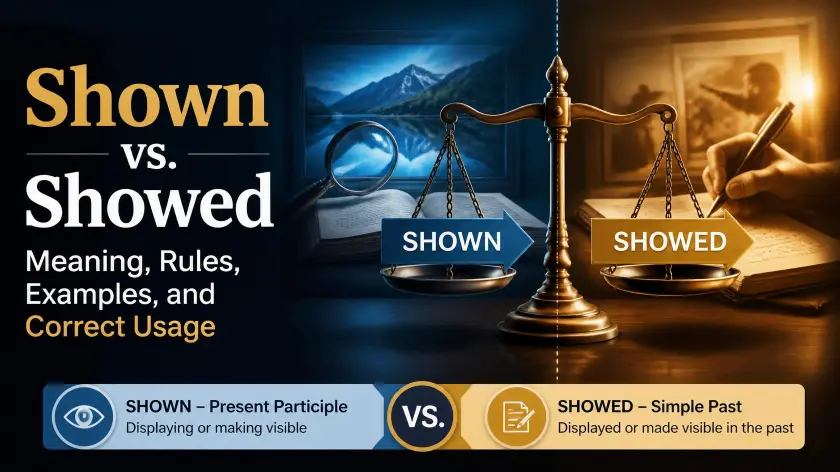
Understanding shown vs showed is important for anyone who wants to improve English grammar and writing accuracy. These two words come from the verb show, but they are used in different grammatical situations. Many people confuse them because both describe something being presented, displayed, or revealed.
The main difference is simple: “showed” is the simple past form of show, while “shown” is the past participle form that usually needs a helping verb like has, have, or had. Knowing when to use each form helps you avoid common mistakes in everyday conversations, professional writing, and academic work.
This guide explains the rule behind shown vs showed, provides clear examples, compares their uses, and gives memory tricks to help you choose the correct word every time.
The Core Rule Explained Simply
The verb show has three main forms:
| Verb Form | Word | Example |
| Base form | show | I show my work. |
| Past tense | showed | I showed my work yesterday. |
| Past participle | shown | I have shown my work before. |
The key difference:
Showed = simple past
Shown = past participle
The word showed can stand alone as the main verb.
Examples:
- She showed me her new book.
- He showed the teacher his project.
- They showed the results last week.
However, shown usually needs a helping verb.
Examples:
- She has shown great improvement.
- The report has shown positive results.
- They have shown their support.
The most common mistake is saying:
Incorrect:
- She has showed me the picture.
Correct:
- She has shown me the picture.
Why?
Because has + past participle is the required structure.
The Two Primary Forms Explained
Category 1: Showed, The Simple Past Form
“Showed” is used when talking about an action that happened and finished in the past.
The structure is:
Subject + showed + object
Examples:
- I showed my friend the photo.
- She showed her skills during the competition.
- The guide showed us the museum.
The action happened at a specific time, even if the time is not always mentioned.
Let’s make this concrete.
Compare:
Simple past:
“She showed me the results yesterday.”
The action happened yesterday and ended.
Present perfect:
“She has shown me the results.”
The action happened before now, and the connection to the present matters.
Quick Test for Showed
Ask yourself:
Is the sentence talking about a completed event in the past?
If yes, use:
showed
Examples:
✓ He showed me the answer yesterday.
✓ They showed the movie last night.
✓ She showed her talent at the event.
Do not use:
✗ He shown me the answer yesterday.
✗ They shown the movie last night.
A simple past sentence does not need a helping verb.
Category 2: Shown, The Past Participle Form
“Shown” is used when the verb needs help from another verb. It often appears after:
- has
- have
- had
- be verbs in passive structures
Examples:
- She has shown excellent leadership.
- They have shown interest in the project.
- The results had shown improvement.
The structure is:
Helping verb + shown
This form is especially common in present perfect, past perfect, and passive voice sentences.
Present Perfect Examples
The present perfect connects a past action to the present.
Examples:
- The study has shown important findings.
- He has shown remarkable progress.
- The company has shown strong growth.
The exact time is not the main focus.
Past Perfect Examples
The past perfect describes something that happened before another past event.
Examples:
- She had shown the documents before the meeting started.
- The research had shown problems earlier.
- They had shown enough evidence.
Passive Voice Examples
“Shown” can also appear in passive sentences.
Examples:
- The painting was shown in the gallery.
- The results were shown on the screen.
- The movie was shown worldwide.
Here, “shown” follows a form of “be,” such as was, were, or is.
Side-by-Side Comparison Table
| Situation | Example | Meaning | Correct Usage |
| Completed past action | She showed the picture yesterday. | A finished past event | Use showed |
| Present connection | She has shown the picture. | Past action connected to now | Use shown |
| Life experience | He has shown leadership skills. | Experience gained before now | Use shown |
| Specific past moment | They showed the results last night. | Action happened at a known time | Use showed |
| Passive sentence | The film was shown in theaters. | Something was displayed or presented | Use shown |
Deep Dive Into Category 1: When to Use Showed
The word showed is the regular past tense of show. It describes a completed action that happened before the present moment.
1. Showing Something in the Past
Use showed when someone presented or revealed something.
Examples:
- She showed her artwork to the class.
- He showed me the correct answer.
- The teacher showed an example.
These actions are complete.
2. Talking About Specific Past Times
Words that often appear with showed include:
- yesterday
- last week
- last year
- earlier
- before
- when
Examples:
- The company showed its new product last month.
- She showed me the email earlier.
- They showed the results during the meeting.
The time reference makes the simple past appropriate.
3. Storytelling and Narration
Writers often use showed to describe events in stories.
Example:
“The character opened the box and showed everyone what was inside.”
The action moves the story forward.
Another example:
“The scientist showed the experiment to the audience.”
The event happened at a particular moment.
Quick Checklist for Showed
Use showed when:
✓ The action is finished.
✓ You describe a past event.
✓ No helping verb appears before the verb.
✓ A specific past time is mentioned.
Examples:
✓ She showed her passport yesterday.
✓ He showed his work last Friday.
✓ They showed the results earlier.
Avoid:
✗ She has showed her passport.
✗ He had showed his work.
Deep Dive Into Category 2: When to Use Shown
The word shown is not the simple past form. It is the past participle. This means it usually cannot work alone.
You need another verb.
Examples:
Correct:
- She has shown her talent.
- They have shown their support.
- The evidence was shown clearly.
Incorrect:
- She shown her talent.
- They shown their support.
1. After Has, Have, and Had
This is the most common use.
Examples:
- The report has shown improvements.
- Researchers have shown new results.
- The team had shown great effort.
Remember:
Has/have/had + shown
Never:
Has/have/had + showed
2. In Passive Voice
Passive voice changes the focus from who performed the action to what received the action.
Examples:
Active:
“The teacher showed the students the answer.”
Passive:
“The answer was shown to the students.”
Other examples:
- The painting was shown at the exhibition.
- The video was shown during class.
- The evidence was shown to the jury.
3. Describing Results or Evidence
“Shown” is common when discussing proof, research, or discoveries.
Examples:
- Studies have shown that exercise improves health.
- The data has shown a clear pattern.
- The results have shown significant changes.
This usage appears frequently in academic and professional writing.
Quick Test for Shown
Ask:
Is there a helping verb before the word?
If yes, choose:
shown
Examples:
✓ Has shown
✓ Have shown
✓ Had shown
✓ Was shown
✓ Were shown
If the verb stands alone:
Use:
showed
Examples:
✓ She showed me.
✓ He showed the way.
The Meaning Shift (or Nuance)
The difference between shown vs showed is not about meaning. Both words come from the same verb and describe the act of presenting, revealing, or displaying something. The difference is about time and sentence structure.
Showed focuses on a completed action in the past.
Example:
- The manager showed the employees the new schedule.
This tells us that the manager performed the action at a finished point in time.
Shown focuses on a completed action connected to another verb form.
Example:
- The manager has shown the employees the new schedule.
The meaning is similar, but the sentence connects the action to the present or another time period.
Here’s why:
English verbs often change depending on whether they are used as simple past verbs or past participles. Understanding this pattern helps with many other verbs, not only show.
Compare:
- I wrote a letter yesterday.
- I have written many letters.
- She broke the glass.
- She has broken the glass.
- They took the opportunity.
- They have taken the opportunity.
The same idea applies:
- She showed the project.
- She has shown the project.
Why the Confusion Persists
The confusion between shown vs showed exists because many English learners assume every past verb follows the same pattern. For many regular verbs, the past tense and past participle are identical.
Examples:
- Work, worked, worked
- Play, played, played
- Visit, visited, visited
Because these verbs do not change, learners may expect:
- Show, showed, showed
However, “show” follows an irregular pattern:
- Show, showed, shown
This pattern is similar to other common verbs:
- Know, knew, known
- Throw, threw, thrown
- Grow, grew, grown
Another reason confusion continues is that people hear informal speech where grammar rules may not always be followed. In casual conversations, some speakers may incorrectly say “has showed,” but standard English requires “has shown.”
Formal vs Casual Contexts
The difference between showed and shown becomes especially important in professional, academic, and formal writing.
Formal Writing
In formal contexts, accuracy matters.
Correct examples:
- The research has shown a significant relationship between the variables.
- The report has shown several areas for improvement.
- The analysis has shown unexpected results.
These sentences sound professional because the grammar structure is correct.
Incorrect:
- The research has showed a significant relationship.
This mistake can make writing appear less polished.
Casual Conversations
In everyday speech, people sometimes make grammar mistakes without noticing.
Examples:
Informal:
“I think she has showed him already.”
Standard:
“I think she has shown him already.”
When speaking with friends, mistakes may go unnoticed. However, when writing emails, essays, reports, or applications, using shown correctly improves clarity and credibility.
Case Studies / Pop Culture Examples
The difference between shown vs showed appears often in news, entertainment, research, and everyday communication.
Example 1: News Reporting
A journalist might write:
“The investigation has shown new evidence.”
This means the investigation produced information that is important now.
A past event would be:
“The investigation showed new evidence last year.”
The difference depends on the timeline.
Example 2: Movies and Television
A review might say:
“The actor has shown incredible talent throughout the series.”
The reviewer is discussing a performance pattern over time.
A scene description might say:
“The actor showed his emotions during the final scene.”
This describes one completed moment.
Example 3: Academic Research
Researchers often use shown because studies connect past discoveries to current knowledge.
Examples:
- The experiment has shown promising results.
- Previous studies have shown similar patterns.
This style is common in scientific writing.
Example 4: Workplace Communication
A manager may write:
“The presentation has shown the team’s progress.”
This focuses on the current impact.
A meeting summary may say:
“The manager showed the presentation yesterday.”
This focuses on the completed action.
Advanced Scenarios & Flowchart
Use this simple decision flowchart to choose the correct word:
Start
Is there a helping verb before the verb?
Yes
Does the sentence contain has, have, had, is, was, or were?
Yes
Use “shown”
Example:
The report has shown improvement.
No
Is the action finished in the past?
Yes
Use “showed”
Example:
She showed the results yesterday.
No
Use “show” or another correct verb form depending on the sentence.
Quick decision rule:
No helping verb + past event = showed
Helping verb + past participle = shown
Quick Reference Table
| Rule | Example |
| Use showed for simple past actions | He showed me the document. |
| Use shown after has, have, or had | He has shown me the document. |
| Use shown in passive structures | The document was shown to me. |
| Use showed with finished past times | She showed it yesterday. |
| Use shown for experiences or results connected to now | The study has shown progress. |
Common Mistakes That Lower Quality
Even experienced writers sometimes confuse shown vs showed. These are the most common mistakes.
Mistake 1: Using “showed” After Has or Have
Incorrect:
- The study has showed improvement.
Correct:
- The study has shown improvement.
The reason is simple: has requires a past participle.
Mistake 2: Using “shown” Without a Helping Verb
Incorrect:
- She shown me the report.
Correct:
- She showed me the report.
“Shown” cannot normally act alone as the main verb.
Mistake 3: Confusing Past Events With Present Connections
Incorrect:
- He has showed his skills many times.
Correct:
- He has shown his skills many times.
The phrase “has many times” requires the present perfect form.
Mistake 4: Ignoring Passive Voice
Some writers forget that passive sentences also use “shown.”
Correct:
- The results were shown on the screen.
Not:
- The results were showed on the screen.
Mistake 5: Following Regular Verb Patterns
Writers may think:
“Played becomes played, so showed becomes showed.”
However, irregular verbs do not always follow regular patterns.
Memory Hacks That Actually Work
Remembering shown vs showed does not require memorizing complicated grammar rules. A few simple tricks can make the difference clear.
Memory Trick 1: Has Holds Hands With Shown
Think:
Has shown
They belong together.
Examples:
- Has shown
- Have shown
- Had shown
If you see these helping verbs, your answer is almost always shown.
Memory Trick 2: Yesterday Means Showed
When you see a finished past time, think:
Yesterday = showed
Examples:
- She showed me yesterday.
- They showed the movie last night.
- He showed the results last week.
Memory Trick 3: Remember the Three Forms
Say this pattern:
Show, showed, shown
Like:
Go, went, gone
Write, wrote, written
The third form is different.
Memory Trick 4: Ask One Question
Before writing, ask:
“Do I have has, have, had, or a form of be?”
If yes:
Use shown.
If no and it happened in the past:
Use showed.
Why Precision Matters (SEO/Authority)
Using correct grammar builds trust. Whether you are writing website content, business emails, academic papers, or professional documents, small language details influence how readers perceive your expertise.
A sentence with the correct verb form feels natural and reliable.
For example:
“The research has shown important results.”
This sounds professional.
“The research has showed important results.”
Readers understand the meaning, but the grammar error can distract from the message.
For SEO content creators, writers, and businesses, grammar accuracy also supports authority. Search engines and readers both value content that is clear, readable, and professionally written.
Correct usage helps your writing appear more trustworthy and improves communication with your audience.
A Quick Quiz
Fill in the blanks with shown or showed.
1. The teacher ______ us the answer yesterday.
Answer: showed
2. The study has ______ promising results.
Answer: shown
3. She ______ her artwork during the competition last month.
Answer: showed
4. The company has ______ strong growth this year.
Answer: shown
5. The movie was ______ in theaters worldwide.
Answer: shown
6. He ______ me his new phone last weekend.
Answer: showed
7. Researchers have ______ that the method works.
Answer: shown
8. The guide ______ visitors around the building yesterday.
Answer: showed
Conclusion
Understanding shown vs showed comes down to recognizing the difference between the simple past tense and the past participle form of the verb show. Use showed when describing a completed action in the past, such as “She showed me the picture yesterday.” Use shown when it follows a helping verb like has, have, had, was, or were, such as “She has shown great improvement.” Mastering this small grammar difference can make your writing clearer, more accurate, and more professional. With regular practice, choosing between these two words becomes natural and helps you avoid one of the most common English verb mistakes.
The easiest way to remember the rule is to connect showed with finished past events and shown with helping verbs or passive structures. When writing emails, articles, essays, or professional documents, correct verb forms create a stronger impression and improve readability. Although people may sometimes use these words incorrectly in casual speech, standard English follows a clear pattern: show, showed, shown. By understanding this pattern and applying the examples provided, you can confidently use both forms correctly in any situation.
Frequently Asked Questions
Is “shown” the past tense of show?
No, shown is not the past tense of show. The past tense form is showed, while shown is the past participle form. The three main forms are: show, showed, shown. For example, “She showed me the letter yesterday” uses the past tense, while “She has shown me the letter” uses the past participle.
Is “showed” ever used with has or have?
No, standard English does not use showed after helping verbs like has or have. The correct structure is has shown or have shown because these helping verbs require the past participle form. For example, “The report has shown progress” is correct, while “The report has showed progress” is grammatically incorrect.
Can “shown” be used without a helping verb?
In most standard English sentences, shown needs a helping verb. It usually appears with words like has, have, had, was, or were. Saying “She shown me the picture” is incorrect. The correct sentence is “She showed me the picture” because showed works as the standalone past tense verb.
Why do people say “has showed” if it is incorrect?
People may say “has showed” because they apply the pattern of regular verbs to the verb show. Many verbs use the same form for past tense and past participle, which can create confusion. However, show is irregular, so the correct pattern is show, showed, shown.
Is “was shown” correct?
Yes, “was shown” is completely correct. This structure uses the passive voice, where shown functions as the past participle. Examples include “The movie was shown in theaters” and “The evidence was shown to the investigators.” In these sentences, shown does not need to be replaced with showed.
How do I know whether to use showed or shown?
Look at the words before the verb. If the sentence has has, have, had, was, or were, you usually need shown. If the verb describes a completed past action without a helping verb, use showed. For example, “He showed the results yesterday” and “He has shown the results.”
Is “shown” more formal than “showed”?
Neither word is more formal. They are simply used in different grammatical situations. Shown may appear frequently in formal writing because academic and professional texts often use present perfect and passive structures. However, showed is equally correct when describing a completed past event.
What are some common phrases with shown?
Many common expressions use shown, especially with helping verbs. Examples include “has shown improvement,” “has shown interest,” “has shown support,” and “has shown potential.” These phrases are common in workplace writing, academic discussions, and reports because they describe evidence or progress.
What are some common phrases with showed?
Common phrases with showed usually describe specific past actions. Examples include “showed me the way,” “showed great courage,” “showed his skills,” and “showed the results.” These phrases are often used when telling stories or describing something that happened at a particular time.
Is “shown vs showed” important in professional writing?
Yes, using shown vs showed correctly improves the quality of professional writing. Grammar mistakes can distract readers and reduce confidence in your message. Whether you are writing reports, articles, emails, or presentations, choosing the correct verb form helps your communication appear more polished and credible.

Callum Mercer is a passionate writer and language enthusiast dedicated to making English easier to understand and use. At Grammarzcore, he shares clear, practical guidance on grammar, word meanings, sentence structure, and everyday English. His writing focuses on explaining confusing language questions in a simple, approachable way, helping students, professionals, and everyday readers communicate with greater clarity and confidence. Callum believes that learning English should feel useful, engaging, and accessible, one well-written sentence at a time.