
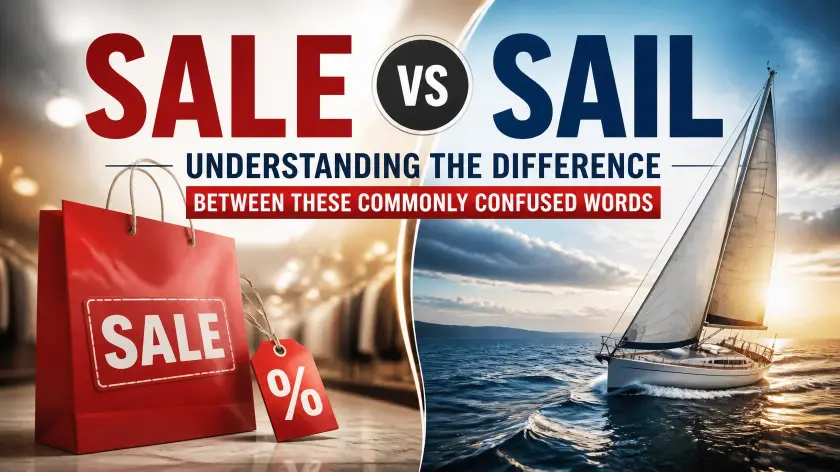
The words sale and sail sound exactly the same, but they have completely different meanings. This makes them a common source of confusion in English writing and conversation. Understanding sale vs sail is important because using the wrong word can completely change the meaning of a sentence.
A sale is connected to buying and selling. It refers to an event where products or services are offered for purchase, or the act of selling something.
A sail is connected to boats, ships, and movement through water or air. It can describe a piece of fabric used to catch wind, or the action of traveling by boat.
Examples:
- The store is having a sale this weekend.
- The boat will sail across the ocean tomorrow.
The pronunciation is identical, but the spelling and meaning are completely different.
Here’s why:
English contains many homophones, which are words that sound the same but have different meanings and spellings.
Other examples include:
- Their, there, and they’re.
- To, too, and two.
- Sea and see.
Sale and sail belong to this same group.
Knowing the difference helps you write more accurately in emails, articles, school assignments, and professional communication.
The Core Rule Explained Simply
The basic rule is:
Use sale when talking about selling, buying, discounts, or transactions.
Examples:
- The store announced a summer sale.
- The house is for sale.
- The company increased its sales.
Use sail when talking about boats, ships, traveling on water, or moving through the air.
Examples:
- The ship will sail tomorrow.
- They learned how to sail.
- The boat has a large sail.
The easiest way to remember:
Sale = shopping and money.
Sail = ships and water.
The context usually makes the correct spelling obvious.
Sale as Buying and Selling
The word sale is a noun that relates to commerce.
It can describe:
- A transaction.
- A discount event.
- The process of selling something.
Examples:
- The store had a huge sale.
- The car is for sale.
- The company reported strong sales.
In all these examples, money or exchange is involved.
Sail as Movement or Equipment
The word sail can be a noun or a verb.
As a noun:
- A sail is a piece of material attached to a boat that catches wind.
Example:
- The boat raised its sail.
As a verb:
- To sail means to travel by boat.
Example:
- They sailed across the Atlantic.
The meaning always connects to movement, water, or wind.
Side-by-Side Comparison Table
| Situation | Example | Meaning | Correct Usage |
| Discount event | The store has a summer sale. | Products are reduced in price. | Use sale |
| Selling property | The house is for sale. | Available to buy. | Use sale |
| Business activity | The company increased sales. | Money earned from selling. | Use sale |
| Boat movement | The ship will sail tomorrow. | Travel by water. | Use sail |
| Boat equipment | The sail caught the wind. | Fabric used on a boat. | Use sail |
| Ocean travel | They sailed around the world. | Traveled by boat. | Use sail |
Deep Dive Into Category 1: Understanding Sale
The word sale is closely connected to business, trade, and purchasing.
Whenever money changes hands because something is being sold, sale is usually the correct word.
When to Use Sale
Use sale when discussing:
- Discounts.
- Purchases.
- Selling items.
- Business transactions.
- Property availability.
Examples:
- The store is having a holiday sale.
- The company made a large sale.
- The apartment is up for sale.
The word appears frequently in advertising and business communication.
Sale as a Discount Event
One of the most common meanings of sale is a temporary price reduction.
Examples:
- Black Friday sale.
- Clearance sale.
- Summer sale.
- Holiday sale.
These events encourage customers to buy products at lower prices.
Example:
“The electronics store announced a weekend sale.”
Meaning:
Customers can purchase items at discounted prices.
Sale as the Act of Selling
Sale can also describe the process of exchanging something for money.
Examples:
- The sale of the building was completed.
- The artwork was sold at a public sale.
- The company recorded several sales.
Here, sale focuses on the transaction itself.
Sale in Business Language
Businesses often use sale in financial contexts.
Examples:
- Sales increased this year.
- The sales team reached its goal.
- The company made a successful sale.
The word is essential in marketing and commerce.
Sale in Real Estate
Real estate commonly uses sale.
Examples:
- The house is for sale.
- The property sale was completed.
- The sale price was reasonable.
In these examples, the word refers to ownership being transferred.
Common Expressions With Sale
For Sale
Meaning:
Available for purchase.
Examples:
- The car is for sale.
- The painting is for sale.
On Sale
Meaning:
Available at a lower price.
Examples:
- Shoes are on sale.
- Electronics are on sale this week.
Sale Price
Meaning:
The reduced or final price of something.
Example:
- The sale price is $50.
Sales Increase
Meaning:
A rise in the amount of products sold.
Example:
- Online sales increased during the holiday season.
Quick Test for Sale
Ask:
1. Is money involved?
If yes, use sale.
Example:
“The store is having a sale.”
2. Is something being bought or sold?
If yes, use sale.
Example:
“The house is for sale.”
3. Can you replace it with “discount event” or “transaction”?
If yes, sale is likely correct.
Quick checklist:
Use sale when:
- Talking about shopping.
- Discussing prices.
- Mentioning business.
- Describing something available to buy.
- Referring to selling activity.
Avoid sale when:
- Talking about boats.
- Talking about ocean travel.
- Describing movement through water.
Deep Dive Into Category 2: Understanding Sail
The word sail belongs to the world of transportation, boats, and navigation.
Unlike sale, it has nothing to do with money or business.
When to Use Sail
Use sail when discussing:
- Boats.
- Ships.
- Ocean travel.
- Wind-powered movement.
- Sailing activities.
Examples:
- The sailors prepared the ship to sail.
- The boat’s sail was damaged.
- They sailed around the island.
Sail as a Noun
As a noun, sail refers to the fabric or structure that catches wind.
Examples:
- The white sail moved in the wind.
- The boat has a large sail.
- The sailor repaired the sail.
The sail helps move the boat.
Sail as a Verb
As a verb, sail means traveling by boat.
Examples:
- They sailed across the ocean.
- She learned to sail last summer.
- The ship sailed into the harbor.
The action involves movement through water.
Sail and Navigation
Sailing is connected with exploration and transportation.
Examples:
- Early explorers sailed across oceans.
- The crew sailed toward new lands.
- The captain sailed through difficult weather.
The word often appears in historical and adventure contexts.
Sail in Modern Usage
Today, sail can describe both professional and recreational activities.
Examples:
- People sail for competition.
- Families sail for vacations.
- Sailors sail professionally.
It can refer to small boats, large ships, and sporting activities.
Common Expressions With Sail
Set Sail
Meaning:
To begin a journey by boat.
Example:
“The ship set sail at sunrise.”
Sail Away
Meaning:
To leave by boat.
Example:
“They sailed away from the island.”
Smooth Sailing
Meaning:
An easy or trouble-free experience.
Example:
“The project was smooth sailing after approval.”
Quick Test for Sail
Ask:
1. Is there a boat or ship involved?
If yes, use sail.
Example:
“They sail every summer.”
2. Is the word connected to wind or ocean travel?
If yes, use sail.
Example:
“The sail caught the wind.”
3. Can you replace it with “travel by boat”?
If yes, sail is correct.
Quick checklist:
Use sail when:
- Talking about boats.
- Describing ocean travel.
- Mentioning sails.
- Discussing navigation.
- Describing movement across water.
Avoid sail when:
- Talking about prices.
- Discussing discounts.
- Describing business transactions.
The Meaning Shift: Sale vs Sail
The difference between sale and sail is not about pronunciation because both words sound identical. The difference comes entirely from meaning and context. These words are examples of homophones, meaning they share the same sound but have different spellings and definitions.
A sale belongs to the world of business, money, and purchasing. It involves the exchange of goods or services for money. Whenever you see words connected to prices, discounts, stores, or transactions, sale is usually the correct choice.
A sail belongs to the world of boats, travel, and movement. It can describe a boat’s equipment or the action of traveling across water.
Compare these examples:
- The store has a big sale this week.
- The ship will sail this week.
The first sentence involves shopping.
The second sentence involves transportation.
The meaning changes completely even though the pronunciation remains the same.
A helpful way to remember the difference is:
Sale is something you find in a store.
Sail is something you find on a boat.
Why the Confusion Persists
The confusion between sale vs sail exists because English contains many words that sound identical but have different meanings. These words can create problems for both native speakers and English learners.
Homophones Create Spelling Challenges
Words like sale and sail are difficult because pronunciation does not provide enough information.
When someone hears:
“The store is having a sale.”
They cannot know which spelling is needed without understanding the meaning.
The listener must use context.
This is why spelling knowledge is important.
Different Word Origins
Although sale and sail sound the same today, they developed from different historical roots.
Sale developed from words connected to selling and exchange.
Sail developed from words connected to ships and movement through water.
Their meanings developed separately, but English pronunciation eventually made them sound alike.
Fast Speech Increases Confusion
In normal conversation, people often pronounce words quickly.
Because sale and sail have the same sound, listeners depend completely on context.
For example:
“I bought it during the sale.”
The shopping context reveals the meaning.
“I watched the boat sail away.”
The ocean context reveals the meaning.
Education Gaps
Many learners memorize vocabulary through sound.
This works for simple words, but homophones require learning both:
- Spelling.
- Meaning.
Knowing only the pronunciation is not enough.
Digital Communication Creates More Mistakes
Text messages and online posts often contain spelling errors because people type quickly.
Someone may write:
“The store has a great sail.”
The reader may understand the intended meaning, but the spelling is still incorrect.
Professional writing requires choosing the correct form.
Formal vs Casual Contexts
Both sale and sail are common words used in formal and casual communication. The correct choice depends on the subject being discussed.
Business and Professional Contexts
The word sale appears frequently in business.
Examples:
- The company increased sales.
- The product is available for sale.
- The sale agreement was signed.
Businesses use sale when discussing:
- Revenue.
- Customers.
- Products.
- Transactions.
Incorrect:
“The company increased its sails.”
Correct:
“The company increased its sales.”
Travel and Maritime Contexts
The word sail appears in travel, transportation, and maritime writing.
Examples:
- The ship will sail tomorrow.
- The crew prepared the sail.
- They sailed across the ocean.
Incorrect:
“The ship will sale tomorrow.”
Correct:
“The ship will sail tomorrow.”
Academic Writing
Students may encounter both words.
Examples:
Business topic:
“The company reported higher sales.”
History topic:
“Explorers sailed across unknown oceans.”
The subject determines the correct spelling.
Online Content and SEO Writing
For SEO writers, spelling accuracy matters because incorrect words reduce trust.
A travel article should use:
- Sail.
- Sailing.
- Sailboat.
A shopping article should use:
- Sale.
- Sales.
- Sale price.
Using the wrong word can make content appear careless.
Case Studies and Pop Culture Examples
Real-world examples make the difference between sale and sail easier to understand.
Case Study 1: Retail Advertising
Retailers frequently use sale.
Examples:
- Holiday sale.
- Flash sale.
- Clearance sale.
A company advertising a discount might write:
“Get 50% off during our summer sale.”
Using sail would completely change the meaning.
Case Study 2: Ocean Adventures
Travel companies use sail when promoting boat experiences.
Examples:
- Sail around tropical islands.
- Sunset sailing tours.
- Learn to sail.
A vacation advertisement might say:
“Sail across beautiful coastal waters.”
This describes a boat journey.
Case Study 3: Historical Exploration
History books often mention sailing.
Examples:
- Explorers sailed across oceans.
- Ships sailed to distant lands.
- Ancient sailors navigated by stars.
Here, sail connects to exploration.
Case Study 4: Everyday Conversation
Imagine two friends talking.
Friend one:
“The shoes were cheap because they were on sale.”
Friend two:
“The boat can sail faster today.”
The surrounding topic immediately reveals the correct spelling.
Advanced Scenarios and Flowchart
Use this decision flowchart to choose between sale and sail:
Start:
Is the sentence about buying, selling, prices, or discounts?
Yes → Use **sale**
Example: The store has a weekend sale.
No → Continue.
Is the sentence about a boat, ship, ocean, or traveling by water?
Yes → Use **sail**
Example: The boat will sail tomorrow.
No → Continue.
Does the word describe a product being available to buy?
Yes → Use **sale**
Example: The house is for sale.
No → Continue.
Does the word describe movement across water?
Yes → Use **sail**
Example: They sailed around the world.
Quick rule:
Money and shopping → sale
Boats and travel → sail
Quick Reference Table
| Word | Meaning |
| Sale | Selling something, buying something, discounts, or business transactions |
| Sail | Traveling by boat or the fabric used to move a boat with wind |
Common Mistakes That Lower Quality
Mistake 1: Using Sail for Shopping
Incorrect:
“The store has a big sail.”
Correct:
“The store has a big sale.”
A store cannot have a sail unless it sells boat equipment.
Mistake 2: Using Sale for Boats
Incorrect:
“The ship will sale tomorrow.”
Correct:
“The ship will sail tomorrow.”
Ships move by sailing, not selling.
Mistake 3: Relying Only on Sound
Because both words sound the same, listening alone is not enough.
You must consider the meaning.
Ask:
“What is the sentence talking about?”
Mistake 4: Confusing Sales and Sails
The plural forms create another challenge.
Sales:
- The company increased sales.
Sails:
- The boat has two sails.
The extra “s” changes nothing about pronunciation, but the meanings are different.
Mistake 5: Ignoring Context Clues
Context usually provides the answer.
Words near sale:
- Price.
- Discount.
- Store.
- Buy.
- Product.
Words near sail:
- Boat.
- Ocean.
- Ship.
- Wind.
- Travel.
Memory Hacks That Actually Work
Memory Hack 1: Sale Has Money
Remember:
Sale starts with S, like spending.
Shopping involves spending money.
Example:
“A sale saves money.”
Memory Hack 2: Sail Has Ships
Remember:
Sail belongs to ships.
A ship has a sail.
Example:
“The sailor raises the sail.”
Memory Hack 3: Picture the Scene
For sale:
Imagine a store sign saying:
“50% OFF SALE.”
For sail:
Imagine a boat moving across the ocean.
Visual memory makes spelling easier.
Memory Hack 4: Use the First Letter Connection
Sale:
S = Shopping.
Sail:
S = Ship.
Both start with S, but the next letters create different meanings.
Why Precision Matters (SEO/Authority)
Using sale and sail correctly improves the quality and professionalism of your writing. Even small spelling differences matter because readers expect accurate information.
This is especially important in:
- SEO articles.
- Product descriptions.
- Business websites.
- Travel content.
- Educational materials.
Imagine a company writing:
“Buy now during our summer sail.”
Customers may understand the meaning, but the mistake makes the brand appear less professional.
Similarly, a travel website writing:
“Sale across the ocean”
creates confusion.
Correct word choice builds credibility.
Search engines also value helpful, high-quality content. Accurate spelling improves readability and user experience.
Professional writers understand that details matter.
Choosing the right word shows:
- Attention to language.
- Respect for readers.
- Strong communication skills.
A Quick Quiz
Fill in the blanks with sale or sail.
1. The store is having a holiday ______.
2. The boat will ______ across the lake.
3. The house is for ______.
4. The captain raised the ______.
5. The company increased its ______ this year.
6. They learned how to ______ during summer vacation.
7. The shoes are on ______ today.
8. The ship’s ______ was damaged during the storm.
Answers
- The store is having a holiday sale.
- The boat will sail across the lake.
- The house is for sale.
- The captain raised the sail.
- The company increased its sales this year.
- They learned how to sail during summer vacation.
- The shoes are on sale today.
- The ship’s sail was damaged during the storm.
Conclusion: Sale vs Sail
Understanding the difference between sale and sail is easy once you connect each word with its meaning. Sale belongs to the world of shopping, business, and transactions, while sail belongs to the world of boats, ships, and travel. Although these words sound exactly the same, their spellings and meanings are completely different. Remembering the simple rule, sale involves spending or selling money, while sail involves ships and movement, can help you avoid mistakes. Using the correct word improves clarity and makes your writing more professional in emails, articles, academic work, and everyday communication.
The confusion between sale vs sail happens because they are homophones, words that have the same pronunciation but different meanings. The best way to choose the correct spelling is to look at the context of the sentence. If you are talking about discounts, products, prices, or purchases, use sale. If you are describing boats, oceans, wind, or traveling across water, use sail. Mastering this small difference strengthens your vocabulary, prevents common spelling errors, and helps you communicate ideas with accuracy and confidence.
Frequently Asked Questions
What is the difference between sale and sail?
The main difference between sale and sail is their meaning. A sale refers to buying, selling, or a discount event involving money. A sail refers to a boat’s equipment or the action of traveling by boat. They sound the same but are used in completely different situations.
Are sale and sail pronounced the same?
Yes, sale and sail are pronounced the same way in standard English. They are homophones, which means they share the same pronunciation but have different spellings and meanings. Because they sound identical, writers must rely on context to decide which spelling is correct.
When should I use sale?
Use sale when discussing business, shopping, prices, or transactions. Examples include “The store is having a sale,” “The house is for sale,” and “The company increased its sales.” If money, buying, or selling is involved, sale is usually the correct choice.
When should I use sail?
Use sail when talking about boats, ships, or traveling across water. It can be a noun, meaning the fabric that catches wind on a boat, or a verb, meaning to travel by boat. Examples include “The ship will sail tomorrow” and “The boat has a large sail.”
Why do people confuse sale and sail?
People confuse sale and sail because they sound identical when spoken. English contains many homophones that share pronunciation but have different meanings and spellings. Without seeing the written word, listeners cannot know which spelling is intended, so understanding the context is essential.
Is “on sail” correct?
No, “on sail” is usually incorrect when referring to discounts. The correct phrase is “on sale,” which means something is available at a reduced price. For example, “The shoes are on sale.” The word sail should only be used for boats, ships, or sailing activities.
Is “the boat is for sale” different from “the boat will sail”?
Yes, these sentences have completely different meanings. “The boat is for sale” means someone wants to sell the boat. “The boat will sail” means the boat will travel through water. The first involves ownership and money, while the second involves movement.
What are some common phrases with sale?
Common phrases with sale include for sale, on sale, sale price, clearance sale, holiday sale, and sales increase. These phrases are commonly used in retail, marketing, and business settings. They all connect to buying, selling, or financial activity.
What are some common phrases with sail?
Common phrases with sail include set sail, sail away, sail across, smooth sailing, and learn to sail. These expressions are connected to boats, navigation, and movement across water. They are often used in travel, adventure, and maritime contexts.
How can I remember the difference between sale and sail?
A simple memory trick is to connect sale with shopping and sail with ships. Sale involves stores, money, and products. Sail involves boats, oceans, and wind. If you picture a shopping sign for sale and a boat with a sail, the difference becomes easier to remember.
Can sale and sail be used interchangeably?
No, sale and sail cannot be used interchangeably. Even though they sound the same, replacing one with the other changes the meaning of a sentence. Using the wrong word can create confusion, so always choose the spelling that matches the topic being discussed.

Callum Mercer is a passionate writer and language enthusiast dedicated to making English easier to understand and use. At Grammarzcore, he shares clear, practical guidance on grammar, word meanings, sentence structure, and everyday English. His writing focuses on explaining confusing language questions in a simple, approachable way, helping students, professionals, and everyday readers communicate with greater clarity and confidence. Callum believes that learning English should feel useful, engaging, and accessible, one well-written sentence at a time.